


The Setup
On August 25, 1896, the Sultan of Zanzibar died unexpectedly at 11:40 in the morning. By the afternoon, his twenty-nine-year-old nephew Khalid bin Barghash had moved into the palace complex and declared himself the new sultan. He had not asked the British for permission. Under the terms of a treaty between Zanzibar and Britain — which had declared the island sultanate a protectorate in 1890 — all new sultans required British approval before taking the throne.
The British consul, Basil Cave, sent a message to Khalid: leave the palace, stand down, and allow the British-preferred candidate to assume the throne. Khalid sent a message back: he was the sultan and had no intention of leaving.
Cave sent an ultimatum. Vacate the palace by 9:00 AM on August 27, or face military action. While Khalid considered his options, the British Royal Navy quietly assembled in Zanzibar harbour: three cruisers, two gunboats, 150 marines and sailors, and 900 pro-British Zanzibari soldiers. Five powerful warships, all pointing at the palace.
Khalid, watching the fleet gather, sent a message to Cave on the morning of August 27: he did not believe the British would actually open fire.
He was wrong.
The War
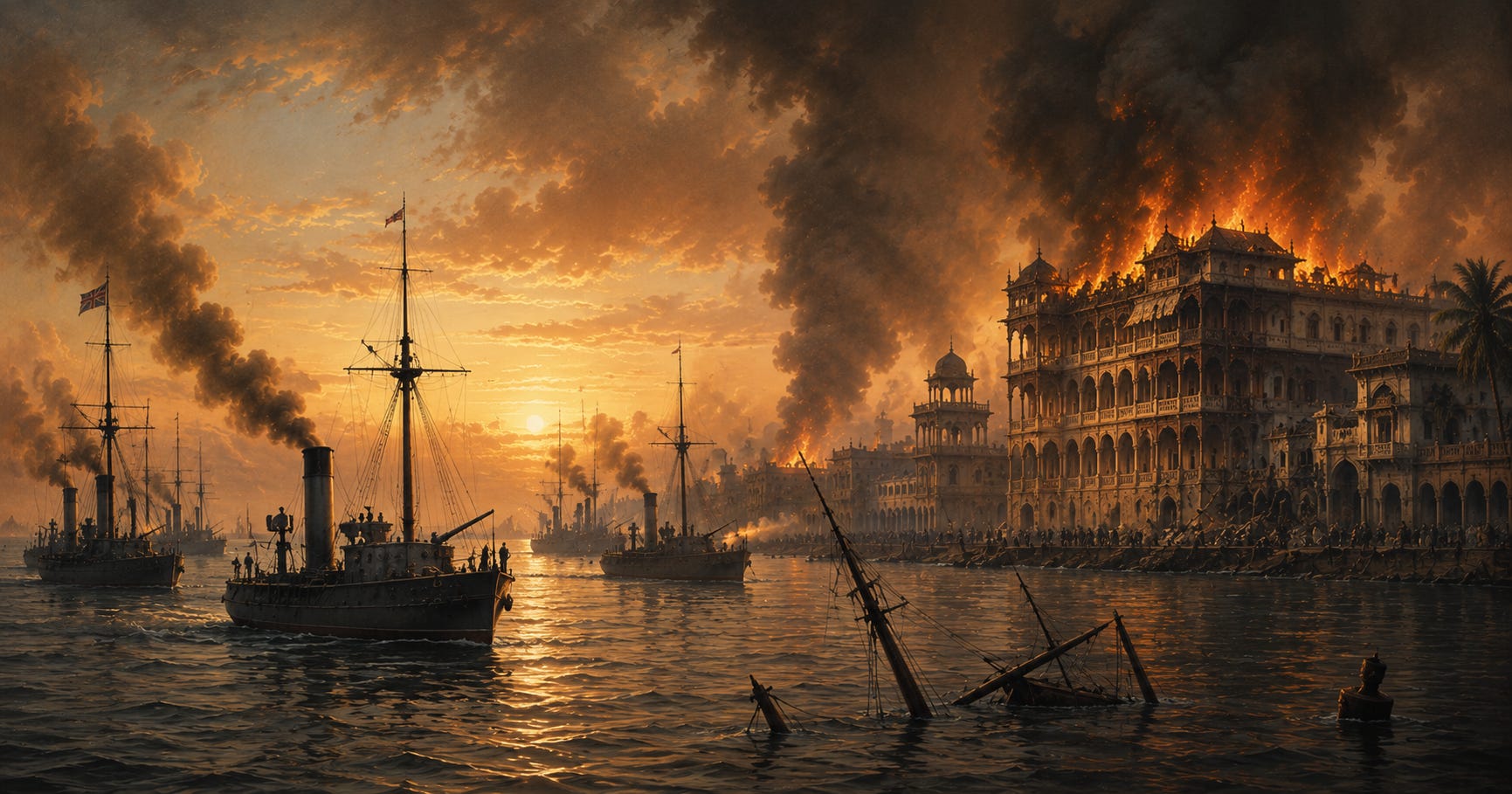
At 9:00 AM the ultimatum expired. At 9:02 AM, HMS Racoon, HMS Thrush, and HMS Sparrow opened fire on the palace complex. The buildings — mostly constructed of local timber, designed as ceremonial spaces rather than defensive fortifications — caught fire almost immediately. The defending artillery was destroyed within minutes. Approximately 2,800 Zanzibari defenders — a mix of palace guards, servants, and civilians who had been recruited in the hours since Khalid’s announcement — had no meaningful answer to the Royal Navy’s firepower.
Meanwhile, in the harbour, a curious development unfolded. The Zanzibari royal yacht — the HHS Glasgow, a British-built ship that had been purchased for a previous sultan and which he and his successors had reportedly never liked or used — was brought into action. Zanzibari soldiers had mounted machine guns and artillery on its decks. It fired at HMS St. George.
The Royal Navy sank it promptly. The Glasgow’s masts remained visible above the harbour waterline for the next eighteen years.
At 9:40 AM, firing ceased. The Zanzibari flag was pulled down from the burning palace. The shortest war in recorded history was over. It had lasted thirty-eight minutes.
The casualty count was deeply lopsided. Approximately 500 Zanzibari fighters were killed or wounded — largely because the high explosive shells from the warships detonated against the palace’s thin timber walls with catastrophic effect. On the British side, one petty officer was wounded. He later recovered.
Khalid himself escaped through a back exit during the bombardment and took refuge in the German consulate. The British demanded his extradition repeatedly. The Germans refused. On October 2, German naval vessels smuggled Khalid out of Zanzibar and into German East Africa — what is now Tanzania. He lived in exile for twenty years until British forces captured him during the East African Campaign of World War I in 1916. He was eventually exiled to the Seychelles and Saint Helena before finally being allowed to return to Tanzania, where he died in 1927.
By the afternoon of August 27, 1896, the British had installed their preferred candidate as the new Sultan of Zanzibar. He immediately moved to abolish the slave trade. It had apparently occurred to him to observe what had happened to the last guy.
The Record
The Anglo-Zanzibar War of 1896 holds the Guinness World Record as the shortest war in recorded history. Various sources cite durations between 38 and 45 minutes — 38 is the most commonly quoted figure. For comparison, an average episode of a Netflix drama runs longer. A standard university lecture runs longer. The war that ended Khalid bin Barghash’s sultanate ran shorter than most morning commutes.
The palace complex where the fighting occurred still stands in Zanzibar’s Stone Town — now a UNESCO World Heritage site. The spot where the Glasgow went down is still there in the harbour, though the masts are long gone. And the record, as far as history is aware, still stands.
The Record Shows
Khalid bin Barghash made one catastrophic miscalculation: he assumed that because the British had not fired on his predecessors, they would not fire on him. He confused precedent with guarantee. The five warships in the harbour were not a bluff — they were a statement about who held actual power in Zanzibar, expressed in the clearest possible terms. The thirty-eight minutes of the Anglo-Zanzibar War are a useful reminder that the shortest conflicts in history are rarely about strategy. They’re about someone refusing to believe what is already obviously true.
Sources
· Wikipedia — Anglo-Zanzibar War (en.wikipedia.org/wiki/Anglo-Zanzibar_War)
· History Today — The Anglo-Zanzibar War (historytoday.com)
· Britannica — Anglo-Zanzibar War (britannica.com/event/Anglo-Zanzibar-War)
· Historic UK — The Shortest War in History (historic-uk.com)
· HowStuffWorks — The World’s Shortest War Lasted Just 38 Minutes (history.howstuffworks.com)
If someone forwarded this to you and you’d like to receive Lost in the Record weekly, subscribe free at lostintherecord.substack.com