


The Birthday
On the afternoon of October 24, 1901, a rowboat pulled away from the American shore of the Niagara River, nearly a mile above the falls. It was towing an oak barrel. Inside the barrel, strapped into a leather harness and packed in with cushions, was a woman who had told the newspapers she was 43.
She was not 43. It was her birthday, and she was 63.
Her name was Annie Edson Taylor. She had been a schoolteacher, a dance instructor and a music teacher. She had never performed a stunt in her life. In a few minutes the boatmen would cut the rope, and the current would carry her toward the Horseshoe Falls, a drop of more than 150 feet. No one had ever ridden a barrel over it.
She was not doing it for the thrill. She was doing it because she was running out of money, and she could not think of another way to get more.
The Teacher
Annie Edson was born on October 24, 1838, in Auburn, New York, one of eight children. Her father owned a flour mill. He died when she was 12, and he left enough money for the family to go on living comfortably.
She trained as a schoolteacher and married a man named David Taylor. They had a son, who died in infancy. Her husband died not long after. Decades later she told a reporter, “I was left a widow at twenty, and have devoted most of my life to others.”
She spent those decades moving. She taught wherever she could find pupils. In the late 1890s she arrived in Bay City, Michigan, hoping to teach dancing and manners to the children of the lumber families, and opened a dance school there. But the lumber business was fading, and so were her classes. In 1900 she moved to Sault Ste. Marie to teach music. She tried San Antonio, Texas. She traveled to Mexico City with a friend to look for work and found none. Then she went back to Bay City.
By then the inheritance was nearly gone. She was in her sixties, widowed, with no children and no steady income. She said she needed money to keep her place among “the best class of people, the cultured and the refined.” What she feared most was ending her life poor.
The Barrel
In July 1901 she read about the Pan-American Exposition, a world’s fair that was drawing crowds to Buffalo, New York, and about how many of those visitors were making the short trip to see Niagara Falls. That gave her the idea. She would do something no one had ever done, in front of the biggest audience she could find.
“Go over Niagara Falls in a barrel,” she said of the plan. “No one has ever accomplished this feat.” A newspaper reported what she hoped to get out of it: enough attention to win a booking on the music-hall stage, and enough money to pay off a mortgage.
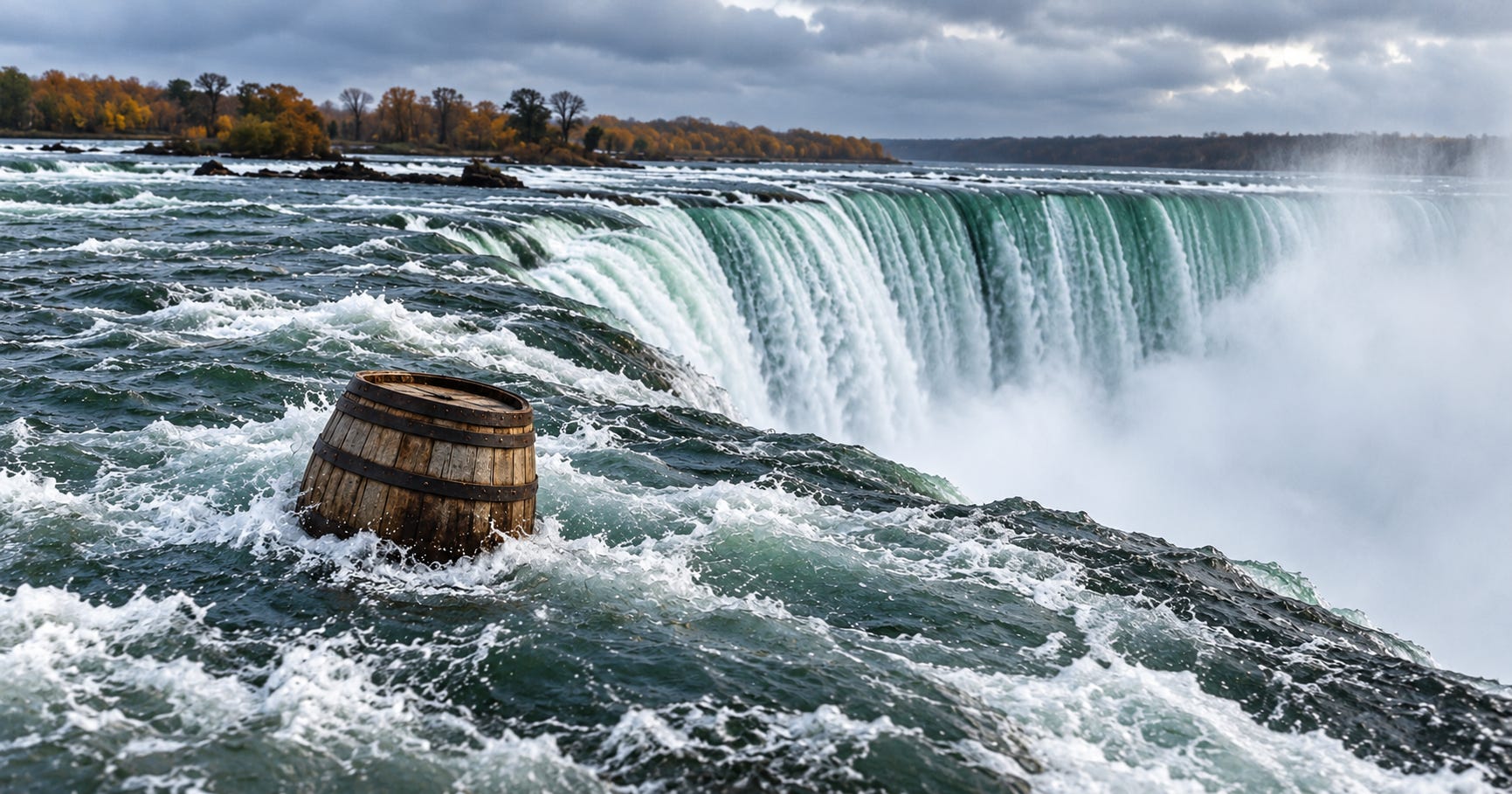
She had the barrel built to her own design. It was made of Kentucky oak and bound with iron, about four and a half feet high and three feet across. An anvil was fastened to the bottom so the barrel would ride upright in the water. Inside were cushions and a leather harness to hold her in place.
She hired a manager from Bay City named Frank M. Russell, who went ahead to Niagara to drum up publicity. When reporters asked her age, she gave it as 43. She believed people would pay more readily to see a younger woman.
The first attempt, on October 23, never left the shore. The wind was up, the river was rough, and the boatmen she had hired refused to tow her out. “We’re afraid to take the chance,” one of them said.
4:23 P.M.
The next day the river was calmer, and the boatmen agreed. They set out from Port Day, on the American side. Taylor climbed into the barrel with a pillow. Her helpers screwed down the lid, forced air inside with a bicycle pump, and plugged the hole with a cork.
A police officer on the shore ordered them to stop. They ignored him.
According to the account in the next morning’s New York Times, the barrel was cut adrift at 4:05 p.m. For eighteen minutes it rode the rapids toward the brink. At 4:23 it went over the Horseshoe Falls, about 300 feet from the center, toward the Canadian shore. Several thousand people were watching. It reached the bottom in less than a minute.
Then it was caught in the churning water below, and for a quarter of an hour nobody could reach it. At 4:40 p.m., men waiting near the Canadian shore finally hauled the barrel onto the rocks. They had to saw away part of the top to get her out.
She was alive. She had a three-inch cut on her scalp behind her right ear, and she was bruised and in shock. She said she had been knocked unconscious on the way down. “But she is alive to-night,” the Times reported, “and the doctors say as soon as she gets over the shock she will be all right.”
She described the ride to a reporter. “I held tightly to the handles,” she said, “and thought only of preventing my head from striking the top of the barrel.” She said the barrel had struck the rocks three times. “I feel like offering a prayer that my life was spared.”
She also wanted it understood that she was not the sort of person who did this kind of thing. “I am not a notoriety seeking woman,” she said, “and have lived a quiet life.”
Doctors kept visitors away from her while she recovered. She also received a proposal of marriage. She turned it down.
She had no interest in doing it twice. “If it was with my dying breath,” she told a reporter that day, “I would caution anyone against attempting the feat.” She said she “would sooner walk up to the mouth of a cannon, knowing it was going to blow me to pieces” than go over the falls again.
She rode a barrel over Niagara Falls so she would not die poor. She survived the falls. She died poor anyway.
What the Barrel Paid
For a little while, it worked. On November 1, the last day of the Pan-American Exposition, she posed for photographs beside her barrel. She went on a lecture tour. But the fame faded fast, and the fortune she had counted on never came.
Then her manager, Russell, disappeared, and he took the barrel with him. It was the one thing she owned that people would pay to see. She hired private detectives to track it down, and much of her savings went to paying them.
She settled in Niagara Falls and set up a souvenir stand near the water. She sold postcards and a short booklet about her trip, and she posed for pictures with tourists. That was how the first person to survive the falls in a barrel made her living for most of the next twenty years.
Others followed her over the edge. Between 1901 and 1995, fifteen people went over Niagara Falls on purpose. Ten of them lived.
In 1906 she talked about making a second trip. She never did. She tried writing a novel. She told people that her failing eyesight was the price of those few minutes in the barrel.
In February 1921, nearly blind and with nothing left, she entered the Niagara County Infirmary in Lockport, New York. She told the staff she was 57. She died there on April 29, 1921, at the age of 82.
She had nothing left, and donations paid for her funeral. Her grave is in Oakwood Cemetery, in a section set aside for the daredevils of the falls. In the same row lies Carlisle Graham, a fellow stunter who helped pull her from the barrel.
The Record Shows
It is easy to file Annie Edson Taylor under daredevils, next to the tightrope walkers and the showmen, and I don’t think she belongs there. She was a 63-year-old widow with no children and no savings, in an age that offered a woman in her position almost nothing to fall back on, and she decided the most valuable thing she had left to sell was her own nerve. I keep coming back to the age she gave the reporters. She took twenty years off because she believed no one would pay to watch an old woman be brave, and then she did something no one of any age had done before her. The falls did not beat her. Growing old without money did.
Know someone who’d want to hear this one? Tap the restack arrows at the bottom of this post, or forward this email.
Sources
· New York State Parks, “Remembering The Queen of The Mist,” January 12, 2021 (https://nystateparks.blog/2021/01/12/remembering-the-queen-of-the-mist/)
· Oakwood Cemetery, Niagara Falls, “Annie Edson Taylor” (https://oakwoodniagara.org/annie-edson-taylor)
· History.com, “First barrel ride down Niagara Falls” (https://www.history.com/this-day-in-history/october-24/first-barrel-ride-down-niagara-falls)
· Snopes, “Was Annie Edson Taylor the 1st Person To Run Niagara Falls in a Barrel?” Quotes The New York Times, October 25, 1901 (https://www.snopes.com/fact-check/annie-edson-taylor-niagara-falls-barrel/)
· The Buffalo History Gazette, “Over Niagara in a Barrel.” Reprints a newspaper report dated October 24, 1901 (https://www.buffalohistorygazette.net/2016/11/over-niagara-in-barrel.html)
· Confluence Great Lakes Bay, “More than a century ago, a Bay City teacher chased her dreams over the edge of Niagara Falls” (https://confluenceglb.com/annie-edson-taylor-memorial/)
· Mental Floss, “Annie Taylor, the First Person to Cheat Death Over Niagara Falls” (https://www.mentalfloss.com/article/508269/annie-taylor-first-person-cheat-death-over-niagara-falls)
· Wikipedia, “Annie Edson Taylor” (https://en.wikipedia.org/wiki/Annie_Edson_Taylor)
Financially speaking, a lot of people are in these kind of straits again these days. Now they just waste what money they have on the lottery.