


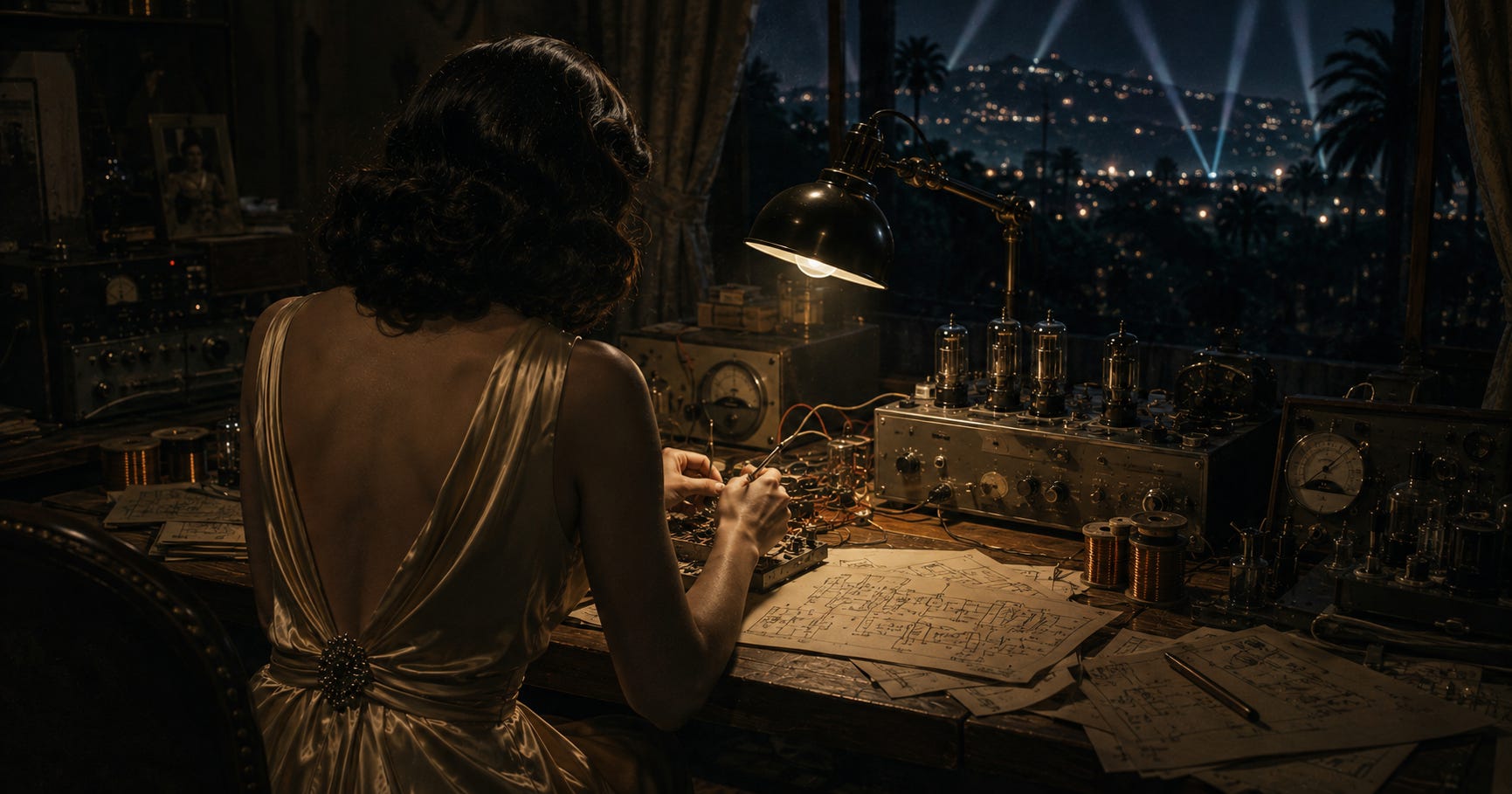
The Actress
Hedy Lamarr was, by virtually every account, the most beautiful woman in Hollywood. Born Hedwig Eva Kiesler in Vienna, Austria in 1914 into a Jewish family, she began acting as a teenager, fled an unhappy marriage to a wealthy Austrian arms dealer, and reinvented herself in America as Hedy Lamarr — a name chosen by MGM studio head Louis B. Mayer himself.
Through the late 1930s and 1940s she appeared in film after film — Algiers, Boom Town, Samson and Delilah — becoming one of the biggest stars in the world. Magazine covers. Advertising contracts. The full weight of Hollywood’s glamour machine behind her. She was described as impossibly beautiful, aloof, mysterious. Nobody thought to ask what she was doing after hours.
What she was doing after hours was inventing.
After long twelve and fifteen hour days on the MGM lot, while other stars went to parties or dinner, Lamarr went home to what she called her “inventing table.” She had been tinkering with ideas since childhood — her curiosity was boundless and her mind was restless. Hollywood bored her. The inventing table did not.
The Problem
It was 1940. Europe was at war. Lamarr, who had fled Austria and whose background gave her a particular awareness of the Nazi threat, wanted to contribute something to the Allied war effort beyond selling war bonds — which is what the Navy would eventually tell her to do instead.
She had a specific technical problem in mind. Radio-controlled torpedoes were a promising weapon against German naval vessels — but they had a critical vulnerability. The enemy could detect the radio frequency being used to guide the torpedo and jam it, sending it off course. What was needed was a way to send a guidance signal that couldn’t be jammed.
Lamarr had spent years around her first husband’s arms manufacturing business, absorbing technical conversations she was not supposed to be listening to. She understood the problem. And she had an idea.
She contacted George Antheil — an avant-garde composer she knew socially — because she needed someone who understood synchronized systems. Antheil was famous for a piece called Ballet Mécanique that required sixteen synchronized player pianos. Synchronization was precisely his specialty.
Together they developed what they called frequency hopping — a method by which both the transmitter and receiver would rapidly and randomly jump between radio frequencies in a synchronized pattern. If the enemy tried to jam the signal on one frequency, the transmission had already moved on. The signal became, in effect, impossible to intercept or block.
On August 11, 1942, US Patent No. 2,292,387 was granted for a “Secret Communication System.” The inventors listed were Hedy Kiesler Markey — Lamarr’s legal name at the time — and George Antheil. Lamarr donated the patent to the US government. She received nothing for it.
The Rejection and the Legacy
The Navy reviewed the patent and declined to use it. An official reportedly told Lamarr she could do more for the war effort by using her celebrity to sell war bonds. The patent sat classified and unused. In 1959 — seventeen years after it was filed — it expired. Lamarr never saw a cent from it.
Then the Cold War changed the calculation. Military engineers began revisiting rejected wartime technologies, and Lamarr and Antheil’s frequency hopping concept resurfaced. By the 1960s the Navy was quietly incorporating spread-spectrum principles into its secure communications systems — without crediting the inventors. The technology was kept classified until the 1980s.
It wasn’t until the late 1990s that a group of engineers realized that “Hedy Kiesler Markey” listed on the old 1942 patent was the Hollywood legend Hedy Lamarr. In 1997 — fifty-five years after the patent was filed — the Electronic Frontier Foundation gave her a Pioneer Award. She was eighty-two years old. “It’s about time,” she reportedly said.
The principles behind frequency hopping are foundational to spread-spectrum communications — the technology underlying Bluetooth, secure military communications, and elements of modern wireless networking. Every time you connect a wireless device, you are in some small way using an idea that a Hollywood actress developed at her inventing table after a twelve-hour day on set, because she was bored with parties and wanted to help win a war.
Hedy Lamarr died in January 2000 at eighty-five. She was inducted into the National Inventors Hall of Fame in 2014 — fourteen years after her death. Her patent had expired fifty-five years before the world got around to thanking her.
The Record Shows
Hedy Lamarr spent her life being seen entirely wrong. The world saw a beautiful face and assumed there was nothing more to find. She spent her evenings proving them wrong at a table nobody knew existed, solving problems nobody asked her to solve, inventing things nobody credited her for. She was told to sell war bonds. She invented spread-spectrum communications instead. The two things are not equivalent, and history — eventually, slowly, posthumously — figured that out.
Sources
· Wikipedia — Hedy Lamarr (en.wikipedia.org/wiki/Hedy_Lamarr)
· History.com — How Hollywood Star Hedy Lamarr Invented the Tech Behind Wi-Fi (history.com)
· National WWII Museum — Hedy Lamarr’s WWII Invention Helped Shape Modern Tech (nationalww2museum.org)
· National Geographic — Who Was Hedy Lamarr? (nationalgeographic.com)
· Women’s History — Biography: Hedy Lamarr (womenshistory.org)
If someone forwarded this to you and you’d like to receive Lost in the Record weekly, subscribe free at lostintherecord.substack.com