


The Woman
Violet Constance Jessop was not supposed to live long enough to survive anything.
Born in 1887 on the Argentine Pampas to Irish immigrant parents — her father a sheep farmer, her mother a stewardess — Violet contracted tuberculosis as a child. Doctors gave her months to live. She declined to cooperate. She recovered fully, which was, for the era, something close to miraculous.
When her father died young, the family moved to England. When her mother fell ill at sea, Violet — 21 years old, with no qualifications and no plan — stepped in to become the family’s sole provider. She applied to be a stewardess on ocean liners. Employers were reluctant. She was too young, they said. Too pretty. She would cause problems with the crew.
Violet, who spoke English, Spanish, and French, who had cared for her younger siblings since childhood, who had already survived a disease that should have killed her, was not discouraged. She got the job.
She had absolutely no idea what she was signing up for.
The First Time
In 1911, Violet joined the White Star Line and was assigned to the RMS Olympic — the largest ship in the world and the first of three magnificent sister ships built to be the new gold standard of transatlantic travel. The other two were the Titanic and the Britannic.
Violet was happy on the Olympic. Then, in September 1911, the Olympic collided with the British warship HMS Hawke in the Solent. The impact tore a massive hole in the ship’s hull. Nobody died. The Olympic limped back to port. Violet kept her job.
A few months later, her friends persuaded her to transfer to the Olympic’s brand new sister ship for its maiden voyage. It would be, they said, a wonderful experience. Violet dressed in a new ankle-length brown suit, climbed into a horse-drawn cab, and went to join the Titanic.
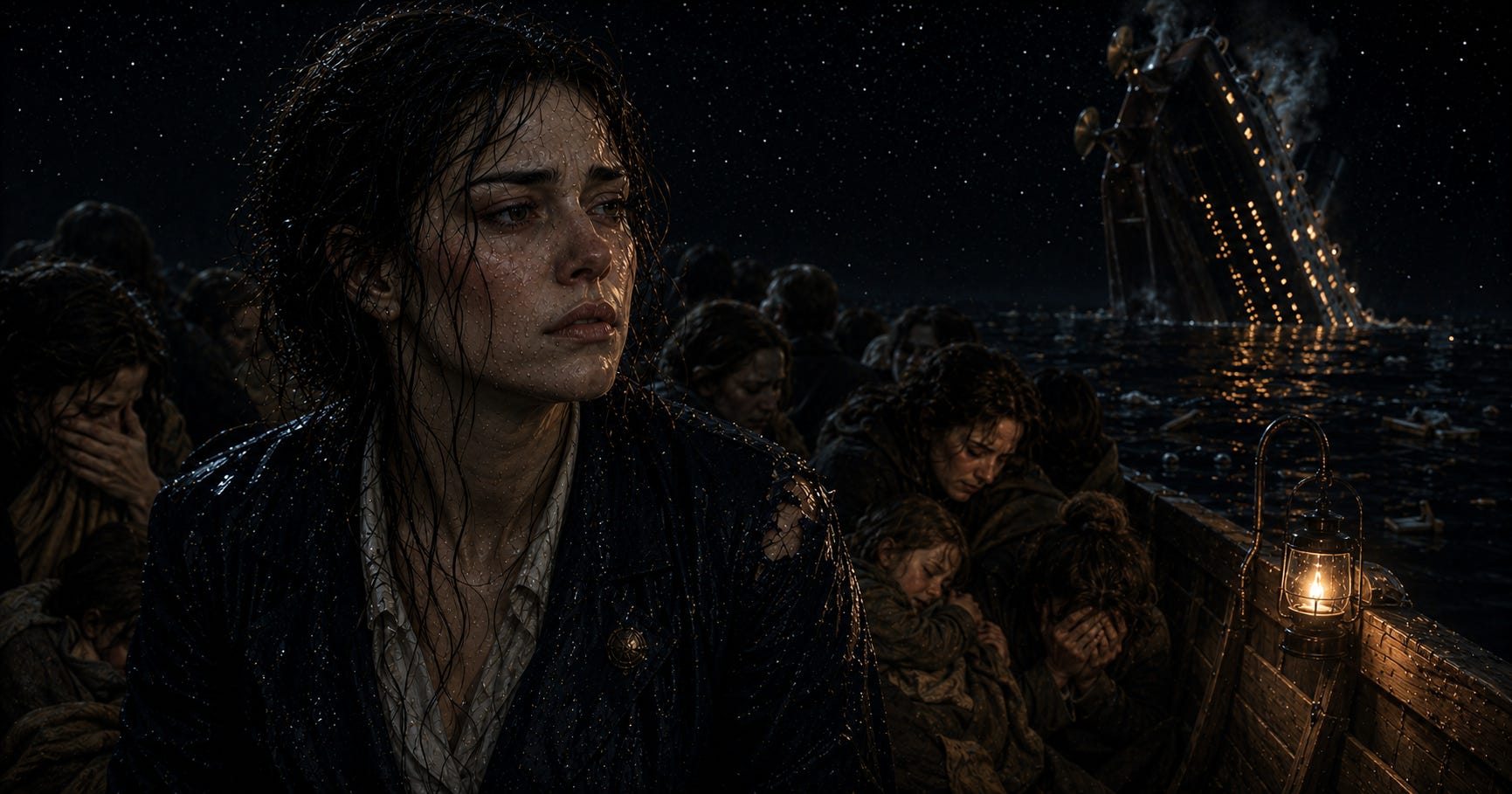
On the night of April 14, 1912, the Titanic struck an iceberg. Violet was ordered up on deck to serve as a calm example for the non-English speaking passengers who couldn’t follow the crew’s instructions. She watched as the lifeboats were loaded. She was placed in Lifeboat 16. As the boat was being lowered, an officer leaned over and handed her a baby to look after.
She held the baby through the night. Eight hours later, the RMS Carpathia arrived and pulled them from the water. As Violet stood on deck, a woman rushed forward, grabbed the baby from her arms without a word, and disappeared into the crowd. Violet never learned who the woman was, or whose baby it had been. Decades later, she received a telephone call on a stormy night from a woman who said: “I was that baby.” Then laughed. Then hung up.
Violet returned to Southampton. She went back to work. She was 24 years old and had already survived two disasters at sea. She was just getting started.
The Second Time
When World War I broke out, Violet enrolled with the British Red Cross as a nurse. She was assigned to the HMHS Britannic — the youngest of the three White Star sister ships, now converted into a hospital vessel carrying wounded soldiers from Gallipoli.
On the morning of November 21, 1916, Violet had just returned from morning Mass and sat down to breakfast when an explosion shook the ship. The Britannic had struck a German mine in the Aegean Sea. It began to sink immediately — faster than the Titanic had.
Violet made it to a lifeboat. But the Britannic’s engines were still running, and its massive propellers were pulling lifeboats back toward the stern. Violet jumped into the sea. The ship’s keel struck her head as she went under. She survived — with a fractured skull she wouldn’t discover for years, when she finally visited a doctor about persistent headaches.
She was pulled from the water by a British destroyer. On deck, soaking wet, she spotted two doctors she had knelt beside at Mass that very morning. One looked at her and said: “I know what saved you today, young lady.”
She had been at sea for five years. She had survived a collision, a sinking, and a mine strike. She had worked all three Olympic-class sister ships through all three of their disasters.
What She Did Next
She went back to work.
Not immediately — she took a short break, she later wrote, because she needed to get back before she lost her nerve. But in 1920, Violet signed on once more with the restored Olympic — the same ship where it had all started — and continued working as a stewardess for another thirty years.
She sailed around the world twice on the Red Star Line’s flagship Belgenland. She worked for the Royal Mail Line. She retired in 1950 at the age of 63, having spent 42 years at sea without another incident. She moved to a sixteenth-century thatched cottage in the English countryside, kept laying hens, tended her garden, and filled her home with mementoes from four decades on the water.
She died in 1971 at 83 — of congestive heart failure, in her bed, far from any ocean. She left behind a memoir that wasn’t published until 1997, long after she was gone.
History called her “Miss Unsinkable.” She preferred, simply, stewardess.
The Record Shows
What’s remarkable about Violet Jessop isn’t the disasters. It’s what she did after each one. She didn’t retreat. She didn’t let catastrophe define the terms of her life. She went back — not out of recklessness, but because the sea was what she knew, and what she knew was how she took care of the people she loved. Most of us will never face anything close to what Violet faced. But most of us know the feeling of going back to something after it’s hurt us. She just did it with considerably more water involved.
Sources
· Wikipedia — Violet Jessop (en.wikipedia.org/wiki/Violet_Jessop)
· National Geographic — She survived the Titanic, but it wasn’t the only time she faced death at sea (nationalgeographic.com)
· Encyclopedia Titanica — Violet Constance Jessop (encyclopedia-titanica.org)
· Sky History — Unsinkable Violet Jessop (history.co.uk)
· Jessop, Violet. Titanic Survivor: The Newly Discovered Memoirs of Violet Jessop. Sutton Publishing, 1997.
If someone forwarded this to you and you’d like to receive Lost in the Record weekly, subscribe free at lostintherecord.substack.com