


The Night
On the night of April 26, 1777, a messenger arrived at the home of Colonel Henry Ludington in Fredericksburg, New York — now Carmel — exhausted and barely coherent. He had ridden hard from Danbury, Connecticut, twenty-five miles away. The British had attacked. They had burned the town’s military depot, destroying weapons, food, and supplies the Continental Army desperately needed. They were moving. The local militia needed to be called up immediately.
Colonel Ludington commanded a regiment of roughly four hundred men scattered across Putnam County. He needed to be at his home to organize and receive them as they arrived. The messenger who had brought the news was too exhausted to ride further. Someone else had to go — forty miles through rainy, pitch-dark roads, across rough terrain in Putnam County, alerting the militia in village after village, through the night.
Sybil Ludington was sixteen years old. She was the colonel’s eldest daughter, one of twelve children. She knew the roads. She could ride. She volunteered.
Her father let her go.
The Ride
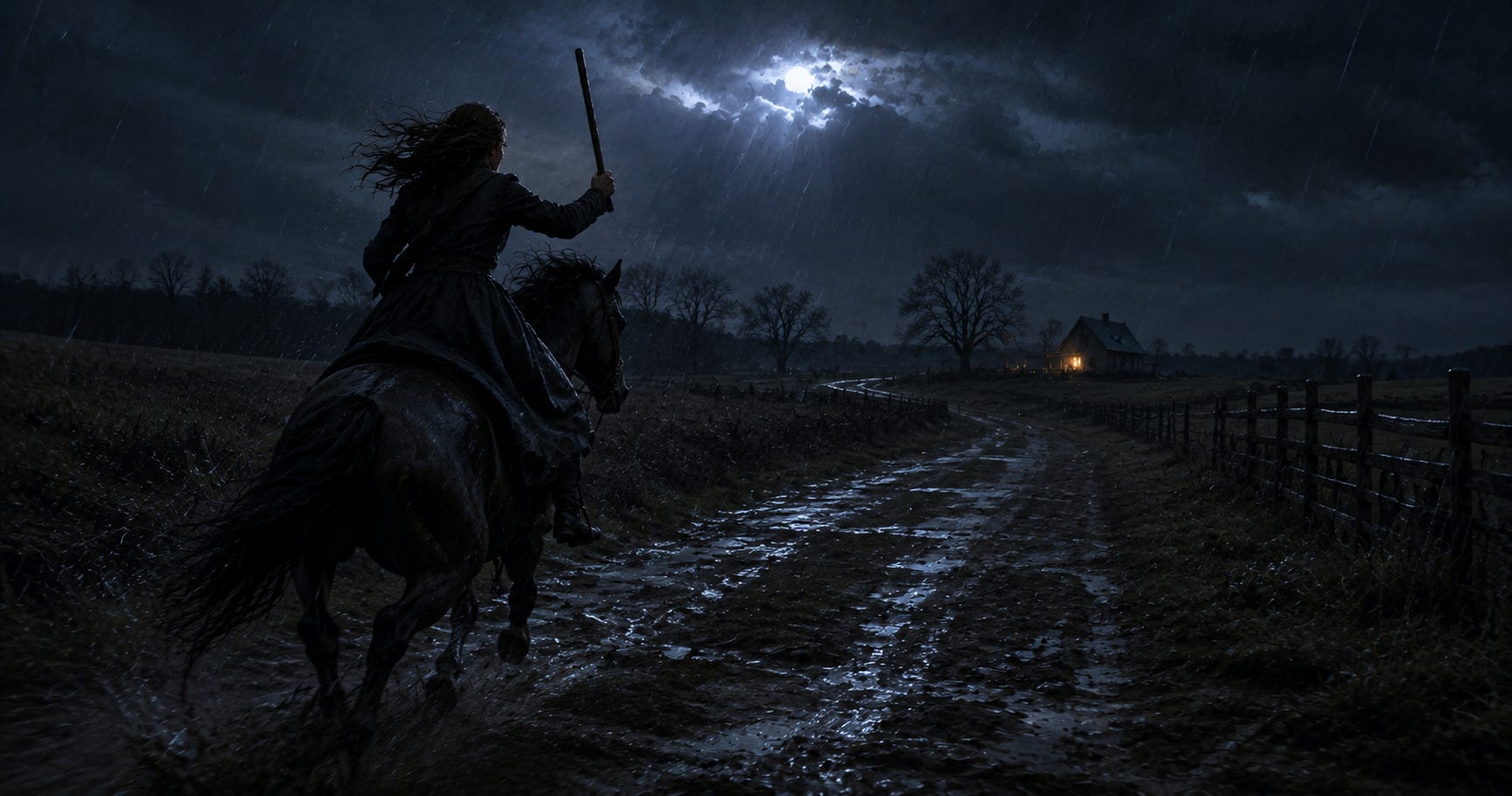
Armed only with a stick to knock on doors and ward off whatever the night might bring, Sybil rode her horse Star through forty miles of Putnam County — through Carmel, Mahopac, Cold Spring, Stormville, and back — in the rain, in the dark, on roads that were rough under good conditions and treacherous in bad weather. Scattered through those roads were the men of her father’s regiment, sleeping in farmhouses, unaware that anything had happened in Danbury.
She rode to each home and knocked until someone answered. The British are coming. Muster at Ludington’s at dawn. Then she rode to the next.
She completed the ride at daybreak. By the time she arrived home, nearly four hundred men had received the call. The regiment assembled and marched — too late to prevent the burning of Danbury, but in time to engage the retreating British forces at the Battle of Ridgefield, pushing them back to Long Island Sound and denying them the clean victory they had sought.
General George Washington personally thanked Sybil Ludington for her service.
Paul Revere’s famous midnight ride in April 1775 covered approximately sixteen miles before he was captured by a British patrol. Sybil Ludington rode forty miles, alone, two years later, in worse conditions, at sixteen years old. She was not captured.
Why You Haven’t Heard of Her
The honest answer involves a poet and a printer and the particular way history gets made.
Paul Revere’s ride became famous because Henry Wadsworth Longfellow wrote a poem about it in 1861 — “Paul Revere’s Ride” — which was published in The Atlantic Monthly, read by millions, and memorized by generations of American schoolchildren. Longfellow took considerable creative liberties with the historical facts, but the poem was thrilling and the name was memorable and it stuck.
Nobody wrote a poem about Sybil Ludington. Partly because her story wasn’t widely documented until 1880, when author Martha Lamb included it in a history of New York based on Ludington family records and interviews. Partly because nothing rhymes with Ludington. And partly because in 1777, the idea that a sixteen-year-old girl’s midnight ride through a rainstorm deserved the same recognition as a grown man’s was not a thought that occurred to the people who wrote history.
It should be noted that some historians have questioned the full documentation of Sybil’s ride — the primary sources are family records and later accounts, not contemporaneous official documents. This uncertainty is worth acknowledging. It applies equally to Revere, whose own ride was not contemporaneously documented in the way legend suggests. What is not in dispute is that Sybil Ludington was a real person, that her father commanded a real regiment, that the British raid on Danbury was real, and that someone rode through Putnam County that night to call those men up. The Ludington family says it was Sybil. Washington’s thanks suggests they were right.
Sybil Ludington married in 1784, had a son, and lived until 1839, dying at seventy-seven in Unadilla, New York. A statue of her stands in Carmel, New York — one of only a handful of outdoor sculptures in the United States depicting a woman. She appears on horseback, stick in hand, calling into the dark.
The Record Shows
History remembers what history chooses to write down — and for a long time, what it chose to write down reflected who was considered worth writing about. Paul Revere got a poet. Sybil Ludington got her family’s word, a statue in a small New York town, and two and a half centuries of obscurity. The ride was the same kind of ride. The night was the same kind of night. The question of why one became a legend and the other a footnote has a straightforward answer that history is still, slowly, correcting.
Sources
· A Mighty Girl — Sybil Ludington: The 16-Year-Old Revolutionary Hero Who Rode Twice as Far as Paul Revere (amightygirl.com)
· Britannica — Today in History: The Midnight Ride of Sybil Ludington (britannica.com) · The Historical Novel — Why Sybil Ludington Wasn’t the Female Paul Revere (thehistoricalnovel.com)
· Lostpine — Sybil Ludington (lostpine.com)
· Lamb, Martha J. History of the City of New York. Barnes and Company, 1880.
If someone forwarded this to you and you’d like to receive Lost in the Record weekly, subscribe free at lostintherecord.substack.com
Paul Revere also being well-known before his ride also no doubt helped him get all the glory.