


The Woman for Sale
In 1906, a newspaper advertisement caught readers off guard. A woman was offering herself for sale. She described herself as a “young woman American slave,” available to the highest bidder.
Her name was Lizzie Magie, and she was not really for sale. She was making a point. Most American women in 1906 could not vote, were paid far less than men, and were expected to depend on a husband to get by. Magie had worked as a stenographer for about $10 a week, which was not enough to live on alone. The ad was a protest dressed up as a stunt. When an Illinois newspaper reported on it, her relatives tried to explain it away as publicity for a book she was writing.
By then, she had already made something that would last far longer than any newspaper stunt. She had invented a board game. You have almost certainly played it. You just know it by another name, and with another man’s name attached to it.
The Stenographer
Elizabeth J. Magie was born on May 9, 1866, in Macomb, Illinois. Her father, James K. Magie, was a newspaper publisher and an abolitionist who traveled with Abraham Lincoln around Illinois in the late 1850s, when Lincoln was debating Stephen Douglas. She grew up around politics and around people who argued about how the world ought to work.
As an adult she lived in the Washington, D.C., area and worked as a stenographer and typist at the Dead Letter Office, where undeliverable mail ended up. She also wrote short stories and poems, performed comedy, and acted on the stage.
And she became a follower of an economist named Henry George. His widely read 1879 book, Progress and Poverty, argued that a small number of people grew rich simply by owning land, collecting rent from everyone who had to use it. His solution was a single tax on the value of land, which he believed would discourage speculation and spread wealth more fairly. His followers called the idea “the single tax.”
Magie wanted to teach it. She decided the best way to teach it was to let people play it.
The Landlord’s Game
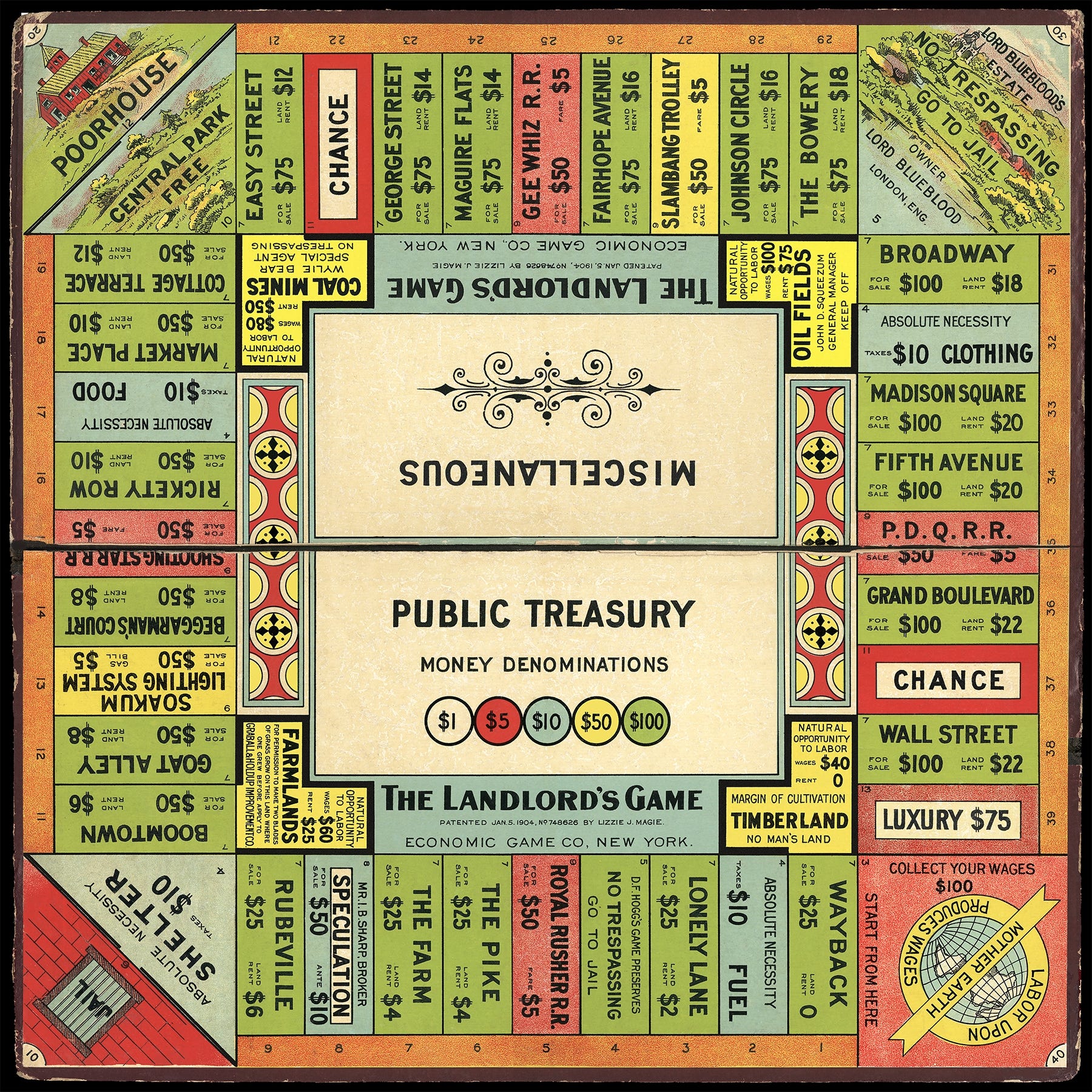
On March 23, 1903, Magie, then living in Brentwood, Maryland, applied for a patent on a game board. It was granted on January 5, 1904, as U.S. Patent No. 748,626. She called her creation The Landlord’s Game.
Anyone who has played Monopoly would recognize it at a glance. A square board with nine spaces along each side. Properties to buy and rent to collect. Railroads. Light and water franchises, the ancestors of the utilities. Every trip around the board paid wages of $100. The corners held a Public Park, a Poorhouse for players who went broke, and a Jail.
But Magie wasn’t just making a pastime. She was making an argument. In a later patent she explained that the object of the game was “not only to afford amusement to the players, but to illustrate to them how under the present or prevailing system of land tenure, the landlord has an advantage over other enterprises and also how the single tax would discourage land speculation.”
To make the lesson unmistakable, she wrote two sets of rules. Under the anti-monopolist rules, everyone was rewarded when wealth was created. Under the monopolist rules, the goal was to pile up wealth and crush your opponents. Play both, and you could see for yourself which one made a better world.
“Let the children once see clearly the gross injustice of our present land system,” she wrote, “and when they grow up, if they are allowed to develop naturally, the evil will soon be remedied.”
A Game Nobody Owned
In 1906, the same year as the advertisement, Magie and two partners formed the Economic Game Company to publish her game. In 1910 she married Albert Wallace Phillips. When her original patent ran out, she patented an updated version, granted on September 23, 1924.
But the game was spreading faster than any company could sell it. People drew their own boards by hand and passed the rules along to friends, the way families pass down a recipe. It caught on among left-leaning intellectuals in the Northeast, and especially among college students and economics professors. Scott Nearing, who taught economics at the Wharton School in Philadelphia, used it with his students. Homemade versions circulated under names like “Monopoly,” “Finance,” and “Auction.”
In Atlantic City, New Jersey, a community of Quakers took it up and renamed the properties after their own streets: Atlantic Avenue, Kentucky Avenue, Park Place. Those names would become some of the most famous addresses in the world. None of them came from the man who would be credited with the game.
The Salesman
Charles Darrow sold home heaters in Germantown, Philadelphia. After the stock market crash of 1929, he lost his job and worked whatever odd jobs he could find.
In 1932, Darrow and his wife, Esther, went to dinner at the home of Charles Todd, a childhood friend of Esther’s. Todd had picked up the Atlantic City version of the game, and that night he taught it to his guests.
Darrow saw something he could sell. He began making copies, hired a professional artist to improve the look of the board, and by 1934 he was selling it through department stores in Philadelphia and through FAO Schwarz in New York. In March 1935, he sold the game to Parker Brothers. That December, he received a patent for it in his own name.
Parker Brothers presented Darrow as the game’s sole inventor: a struggling man in the Depression who had dreamed up a hit. Customers loved the story. By Christmas of 1935, the company had sold 250,000 copies. Monopoly made Charles Darrow the first millionaire game designer in history.
Families were bankrupting each other on a board she had designed. Her name was nowhere on the box.
Five Hundred Dollars
Parker Brothers soon learned that Darrow was not the only person with a claim to the game. Lizzie Magie still held the patent. So in 1935, the company bought it from her for $500.
Magie agreed, hoping that a major company’s backing would finally spread the ideas behind her game. Parker Brothers published two of her other games, Bargain Day and King’s Men, in 1937, and released its own edition of The Landlord’s Game in 1939. But the game everyone wanted was Monopoly, and Monopoly was sold under Darrow’s name.
In January 1936, a Washington newspaper, the Evening Star, interviewed her. Magie was critical of Parker Brothers. She pointed out how closely Monopoly resembled The Landlord’s Game and said she had spent more money making her game than she had ever earned from it. The credit stayed with Darrow.
In the 1940 census, she listed her occupation as “maker of games.” She died on March 2, 1948, in Arlington, Virginia, at the age of 81. Charles Darrow died in 1967, still remembered as the man who invented Monopoly.
The Professor
Her story might have stayed buried if not for another fight over the same game. In the 1970s, Ralph Anspach, an economics professor in San Francisco, created a board game called Anti-Monopoly, meant to teach players about the dangers of monopolies. Parker Brothers took him to court over the name.
To defend himself, Anspach started digging into where Monopoly had really come from. He found Lizzie Magie’s 1904 patent. He found the Quakers of Atlantic City and the hand-drawn boards that had passed from friend to friend for decades. His legal fight dragged on for years, and along the way, the woman who invented the game came back into the record.
The Record Shows
Lizzie Magie built a game to show what happens when a few people own everything and everyone else pays rent. Then a few people came to own her game, and she was paid once, $500, and sent on her way. It is hard to imagine a more perfect demonstration of her point. I keep thinking about those two sets of rules. She gave the world a choice between a game where everyone prospers and a game where one player takes it all, and we kept the second one and put it on shelves across America. The next time someone lands on Park Place and has to hand over everything they have, it’s worth remembering who drew the board, and what she was trying to tell us with it.
Know someone who’d want to hear this one? Tap the restack arrows at the bottom of this post, or forward this email.
Sources
· Wikipedia, “Lizzie Magie” (https://en.wikipedia.org/wiki/Lizzie_Magie)
· Wikipedia, “The Landlord’s Game” (https://en.wikipedia.org/wiki/The_Landlord%27s_Game)
· Wikipedia, “Monopoly (game)” (https://en.wikipedia.org/wiki/Monopoly_(game))
· Wikipedia, “Charles Darrow” (https://en.wikipedia.org/wiki/Charles_Darrow)
· Magie, Lizzie J. “Game-Board.” U.S. Patent No. 748,626, filed March 23, 1903, issued January 5, 1904 (https://patents.google.com/patent/US748626A/en)
· Smithsonian National Museum of American History, “Playing Monopoly (and its discontents) on its 80th anniversary” (https://americanhistory.si.edu/explore/stories/playing-monopoly-and-its-discontents-its-80th-anniversary)
· Smithsonian Magazine, “A New Monopoly Celebrates Women. But What About the Game’s Own Overlooked Inventor?” (https://www.smithsonianmag.com/smart-news/new-monopoly-celebrates-womens-empowerment-what-about-games-overlooked-female-inventor-180973106/)
· NPR, “Ever Cheat At Monopoly? So Did Its Creator: He Stole The Idea From A Woman,” March 3, 2015 (https://www.npr.org/2015/03/03/382662772/ever-cheat-at-monopoly-so-did-its-creator-he-stole-the-idea-from-a-woman)
· PBS American Experience, “Ruthless: Monopoly’s Secret History” (https://www.pbs.org/wgbh/americanexperience/films/ruthless-monopolys-secret-history/)
· SangamonLink, Sangamon County Historical Society, “Elizabeth Magie (’Monopoly’ precursor)” (https://sangamoncountyhistory.org/wp/elizabeth-magie-monopoly-precursor/)
Lizzie Magie's name came back because Ralph Anspach was being sued, not because the record decided to be fair. The 1904 patent was sitting in the file the whole time. What was missing was a man with something at stake who needed it. That's the part I keep turning over: a record doesn't volunteer anything, it only answers.
Smallest version of this I've run into is a tidal crossing in Essex, a casualty roll going back to 1600. The line everyone repeats is "the last death there was 1919." The register disagrees with itself, and two entries in that roll carry no name at all, just "one of the leading farmers" and "a man." Same thing as Darrow's name on the box, only quieter. I wrote it up here if that's your kind of thing: https://sourcedfield.substack.com/p/the-broomway-sourced
Good piece. The two rule sets are the part I hadn't known.