


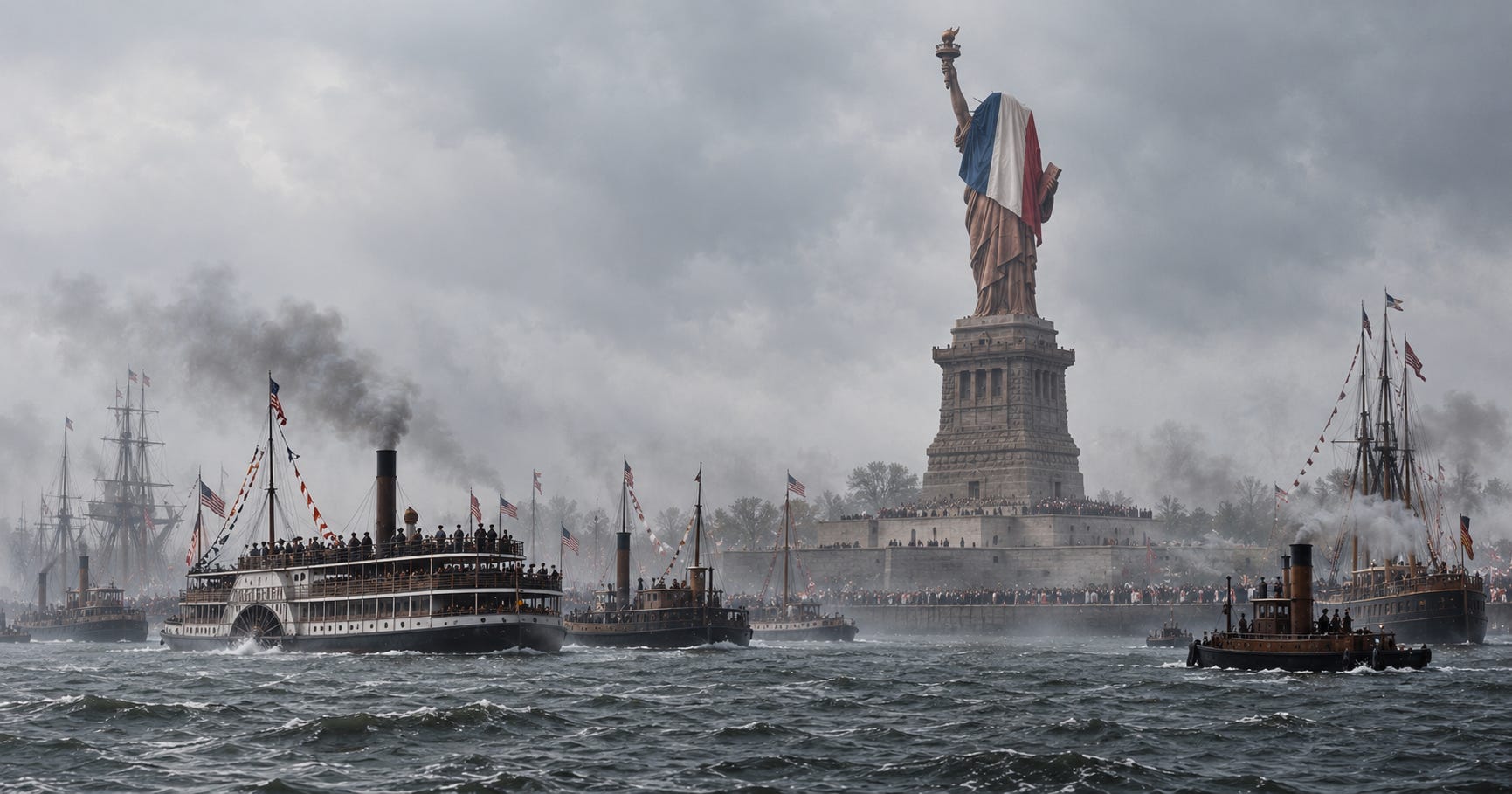
The Unveiling
On October 28, 1886, New York threw a parade for a statue. Hundreds of thousands of people lined the route from Madison Square to the Battery. President Grover Cleveland led the procession, then crossed the harbor by boat to a small island where the Statue of Liberty stood waiting, a French flag draped across her face.
There were four speeches that afternoon. The sculptor, Frédéric Auguste Bartholdi, mistook a pause in one of them for the ending and dropped the flag too soon, and the cheering drowned out the rest. The general public was not allowed on the island. Only two women were admitted to the ceremony at all. A group of suffragists chartered a boat, got as close as they could, and gave speeches of their own.
In all those hours of ceremony, no one read a certain fourteen-line poem. No one mentioned it. It had been written three years earlier to help pay for the stone pedestal under the statue’s feet.
The woman who wrote it was not there. She was in Europe, and she was dying. Today her poem is the only thing most people can quote about the Statue of Liberty.
The Poet
Emma Lazarus was born in New York City on July 22, 1849, the fourth of seven children. Her father, Moses Lazarus, was a wealthy sugar merchant. Her family traced its roots to the first group of Jewish refugees to reach New York, twenty-three people who arrived in 1654, when the city was still a Dutch outpost called New Amsterdam.
She was educated at home by private tutors, who taught her literature, music, German, French and Italian. She wrote poetry from childhood. When she was seventeen, her father had a collection of her poems and translations printed. It came to the attention of Ralph Waldo Emerson, one of the most admired writers in America. The two began a correspondence that lasted until his death in 1882.
It was not always an easy friendship. In 1874 Emerson published an anthology of poetry and left her out of it. She wrote him an angry letter. He never answered it. Two years later she was a guest at his family’s home in Concord, Massachusetts.
By her early thirties she had published a novel, a verse drama, books of poems and a volume of translations from the German poet Heinrich Heine. She was a familiar name in New York’s literary world. Then history arrived at the harbor.
The Refugees
In 1881, the Russian czar Alexander II was assassinated. A wave of violent attacks on Jewish communities followed, and thousands of Russian Jews fled. Many of them landed in New York with nothing.
Lazarus went to meet them. In 1881 and 1882 she visited the refugees housed on Ward’s Island, in the East River. She taught English to new arrivals. She volunteered for the Hebrew Emigrant Aid Society and helped found the Hebrew Technical Institute, which trained immigrants for skilled work. She wrote essays defending them in The Century, one of the leading magazines of the day.
Between November 1882 and February 1883 she published fifteen open letters in a weekly paper, The American Hebrew, under the title “An Epistle to the Hebrews.” In 1883 she traveled to England and France to raise money for a society she had started to help the refugees resettle and find work.
It changed her writing, and it changed what she thought America was for.
Verses to Order
Meanwhile, the statue had a money problem. France was giving the United States the statue itself. Americans were supposed to pay for the pedestal, and the fund was short. At one point the committee in charge had only $3,000 in the bank and stopped work.
In 1883, organizers planned an art exhibition and auction in New York to raise money. They asked well-known writers to donate manuscripts. Mark Twain gave one. Lazarus was asked too, and at first she declined. She did not write poems to order.
A writer named Constance Cary Harrison, who was helping to organize the event, changed her mind. Harrison urged her to think of the statue from the point of view of the refugees she had been visiting, the people who would see it as their ships came in.
A manuscript of the poem is dated November 2, 1883. Lazarus called it “The New Colossus.” The statue she was writing about was not yet in America. It was still in Paris, and it would not arrive in New York for another year and a half.
Within days she had written a second sonnet to go with it. She called that one “1492,” after the year Spain expelled its Jews. The link she was drawing was not subtle. The exiles of her own family’s past and the exiles arriving in the harbor were part of the same story.
The Colossus of Rhodes was one of the wonders of the ancient world, a giant bronze figure of a god. Lazarus opened her poem by rejecting it: “Not like the brazen giant of Greek fame.” Her statue would be something else. She gave it a name, “Mother of Exiles.” Then she let it speak:
“Give me your tired, your poor, / Your huddled masses yearning to breathe free.”
The poem was read aloud at the exhibition’s opening in December 1883, before a crowd that The New York Times put at nearly 1,500 people. It was printed in the exhibition catalogue. The poet James Russell Lowell wrote to tell her that he liked her sonnet “much better than I like the statue itself.” Her sonnet, he said, “gives its subject a raison d’etre.” A reason to exist.
And then it was put away. The pedestal was eventually paid for by a newspaper campaign that collected about $102,000 from some 120,000 donors, most of whom gave less than a dollar. The newspaper’s publisher, Joseph Pulitzer, had promised to print the name of every person who gave. One donation was a dollar from a group of children who had been saving it to go to the circus. The exhibition closed. When the statue was unveiled three years later, the poem written for it played no part.
She wrote the words before the statue had ever stood in New York. When it finally did, it was unveiled without a word of hers.
Thirty-Eight
Her father died in March 1885. Two months later she sailed for Europe, and she stayed more than two years. By the summer of 1886, the summer before the statue was dedicated, she was seriously ill. The cause was most likely Hodgkin’s lymphoma.
She used the time she had left to put her poems in order, so they could be published after she was gone. She did not arrange them by date. She put “The New Colossus” first.
She came home to New York in September 1887 and died on November 19, 1887. She was 38 years old. The next day, The New York Times published her obituary, calling her “an American Poet of Uncommon talent.” It did not mention the sonnet.
The Bookshop
Fourteen years later, in 1901, a New Yorker named Georgina Schuyler was looking through a bookshop when she came across a volume that contained the poem. Schuyler had been a friend of Lazarus. According to the National Park Service, that discovery set her to work. She organized a campaign to bring the sonnet back.
In 1903, a bronze plaque bearing the poem was mounted on an inner wall of the statue’s pedestal. The inscription says the tablet was placed there “in loving memory of Emma Lazarus.”
By then the harbor had changed. The immigration station on Ellis Island, a short distance across the water from the statue, had opened in 1892. In 1903 alone, about 600,000 immigrants passed through it. The statue had been conceived as a monument to liberty and to the friendship between two nations. More and more, people saw it the way the poem did.
The plaque is still there, on display inside the pedestal. The poem’s last line reads: “I lift my lamp beside the golden door!”
The Record Shows
The men who paid for the Statue of Liberty and the men who made speeches at its feet thought they knew what it meant. It took a poet who had spent her days with refugees to see what it would mean to the people sailing past it. Emma Lazarus was not there when the statue was dedicated and never knew her poem would be remembered, but I think she had some sense of what she had made. She was dying, sorting through a lifetime of work, and she moved fourteen lines written for a fundraiser to the very front. Monuments do not explain themselves. Someone has to say what they are for, and the person who says it best is not always the one invited to the ceremony.
Know someone who’d want to hear this one? Tap the restack arrows at the bottom of this post, or forward this email.
Sources
· National Park Service, Statue of Liberty National Monument, “Emma Lazarus” (https://www.nps.gov/stli/learn/historyculture/emma-lazarus.htm)
· Jewish Women’s Archive, “Emma Lazarus,” The Shalvi/Hyman Encyclopedia of Jewish Women (https://jwa.org/encyclopedia/article/lazarus-emma)
· Jewish Women’s Archive, “Emma Lazarus dies at age 38” (https://jwa.org/thisweek/nov/19/1887/emma-lazarus)
· Jewish Women’s Archive, “Emma Lazarus writes ‘The New Colossus’” (https://jwa.org/thisweek/nov/02/1883/emma-lazarus)
· Museum of the City of New York, “The New Colossus” (https://www.mcny.org/node/2256)
· Poetry Foundation, “Emma Lazarus: ‘The New Colossus’” (https://www.poetryfoundation.org/articles/144956/emma-lazarus-the-new-colossus)
· Encyclopaedia Britannica, “Emma Lazarus” (https://www.britannica.com/biography/Emma-Lazarus)
· National Park Service, Ellis Island, “History & Culture” (https://www.nps.gov/elis/learn/historyculture/index.htm)
· The Historical Marker Database, “The New Colossus” plaque, Liberty Island (https://www.hmdb.org/m.asp?m=149136)
· Mental Floss, “The Story Behind the Poem on the Statue of Liberty” (https://www.mentalfloss.com/literature/poetry/story-behind-poem-statue-liberty)
· Wikipedia, “Statue of Liberty” (https://en.wikipedia.org/wiki/Statue_of_Liberty)
· Wikipedia, “The New Colossus” (https://en.wikipedia.org/wiki/The_New_Colossus)