


Christmas Eve, 1971
Juliane Koepcke was seventeen years old and wearing a new dress she had saved up to buy. The day before, she had collected her high school diploma at a ceremony in Lima, Peru — an accomplishment she had worked toward for years, studying between long stretches of life at the remote Panguana research station in the Amazon, where her parents, both German zoologists, had established a research facility. She had convinced them to delay their return to the jungle specifically so she could attend the graduation in person.
Now, on Christmas Eve, she and her mother Maria were at Lima’s Jorge Chávez International Airport, boarding LANSA Flight 508 to Pucallpa. Her father Hans-Wilhelm had urged them to take any other airline. LANSA had a poor reputation — a previous flight had killed all but one of its hundred passengers just a year earlier. “Please don’t fly with LANSA,” he had said. “Any other airline but not LANSA.”
Her mother had booked the seats anyway. They were the only two available on Christmas Eve.
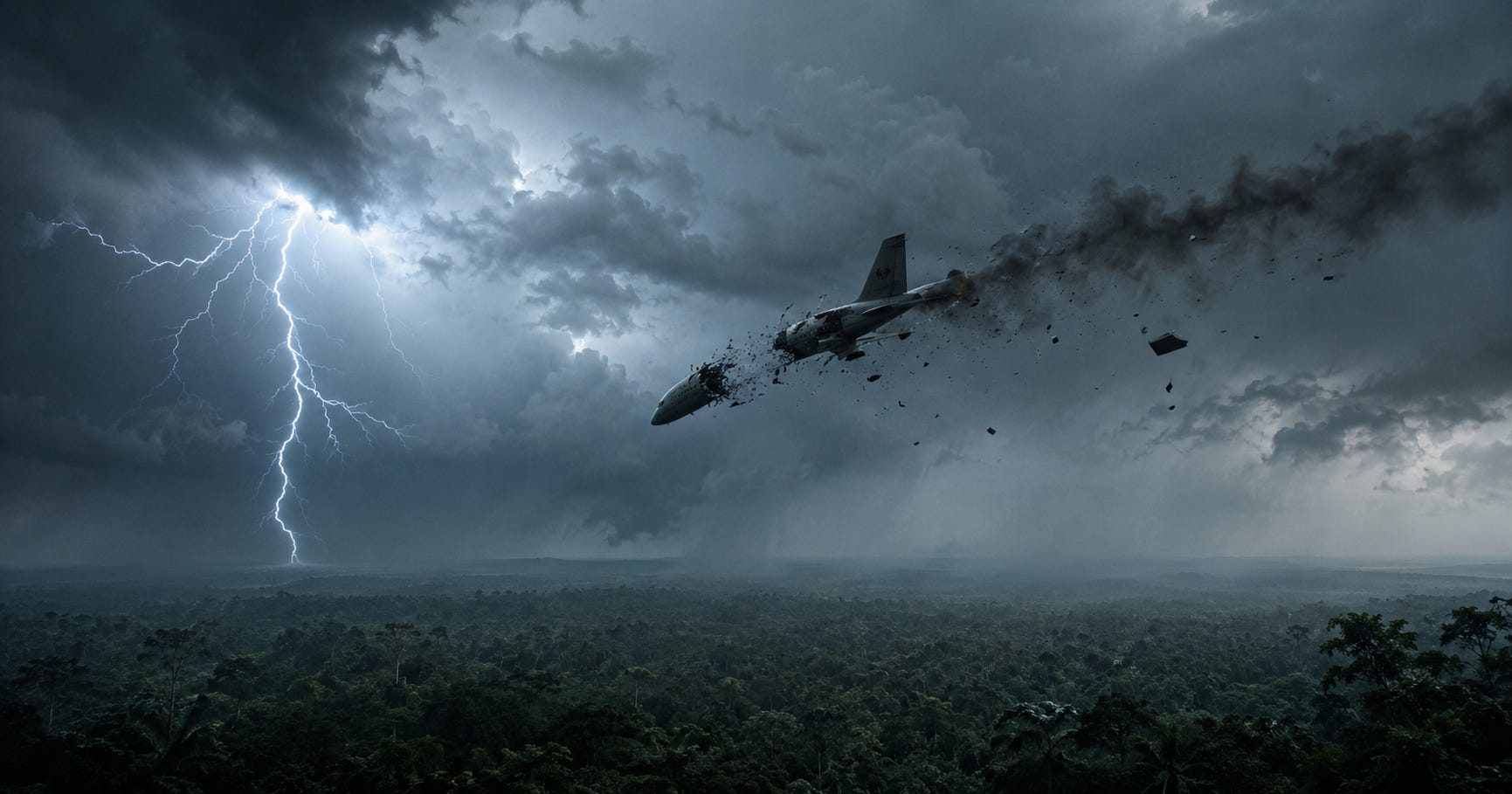
About an hour into the flight, the plane entered a severe thunderstorm. Lightning was constant. Passengers screamed. The turbulence was violent. Then, at approximately 21,000 feet above the Amazon rainforest, a lightning bolt struck the right wing. The aircraft began to disintegrate in midair.
Juliane remembered the Christmas presents in the overhead compartments falling. She remembered seeing a herd of cattle far below through a gap in the clouds. She remembered her mother saying, simply: “That is the end.”
Then she was alone. Still buckled into her row of three seats, separated from the rest of the plane, falling through open sky from ten thousand feet above the jungle floor.
The Fall
Investigators and physicists later concluded that the row of seats had functioned as a crude autorotation device — spinning as it fell, slowing the descent enough to be survivable. The thick jungle canopy absorbed the remaining impact. Juliane landed in the Amazon rainforest, still strapped to her seat, alive.
She woke up on Christmas Day. Around her was silence and jungle. Her collarbone was broken. She had a deep gash on her right arm, a ruptured knee ligament, an eye injury, and a concussion. She was wearing one white sandal. Her dress was torn. She had a small bag of hard candies that had somehow stayed with her.
Of the ninety-two people aboard LANSA Flight 508, fourteen others survived the initial fall. Search parties later found their bodies — they had lived through the crash but died waiting for rescue that never came. Juliane did not wait.
She remembered something her mother had once told her during their years at the research station: in the jungle, follow water downstream. Water leads to larger water. Larger water leads to people.
She found a stream and started walking.
The Eleven Days
For eleven days, Juliane Koepcke walked alone through the Peruvian Amazon in a torn dress and one sandal, injured, surviving on the hard candies she had found and whatever water she could drink from the stream. She had no shoes, no tools, no map, and no way to signal rescue aircraft — several flew overhead during the search, but the jungle canopy was too dense for them to see her.
What she had was knowledge. Her childhood at Panguana had taught her how to read the jungle — which animals were dangerous, which plants to avoid, how to move through difficult terrain. At one point she noticed a group of small frogs near the water and considered eating them. Something made her hesitate. She later learned they were poison dart frogs. Had she eaten them, she almost certainly would have died.
Her right arm had become infected. The wound was infested with botfly larvae — she counted thirty-five of them. She remembered watching her father treat a dog with gasoline to remove parasites and poured fuel from an outboard motor she found at an abandoned camp onto her wound. She watched as the larvae emerged. Then she kept walking.
On the tenth day, she found a small boat moored near a shelter in the jungle. She did not take the boat — it wasn’t hers. She waited. The next day, three lumberjacks returned to the camp and found a seventeen-year-old girl in a torn dress lying on the floor, alive. They cleaned her wounds, fed her, and took her by river to the nearest town. From there, she was flown to a hospital in Pucallpa.
Her father was waiting. Her mother’s body was found seventeen days later, not far from the crash site. She had survived the fall too — and died waiting.
What Came After
Juliane Koepcke returned to Germany, studied biology, earned a doctorate, and went back to Peru to conduct research on bats. She became director of the Panguana research station her parents had founded — the same jungle she had walked out of alone. She married a German entomologist and settled in Munich, working as a librarian at the Bavarian State Collection of Zoology.
For thirty years, she avoided the media almost entirely. In 1998, German filmmaker Werner Herzog finally tracked her down for a documentary called Wings of Hope. Herzog had a personal reason for wanting to tell her story: he had originally been scheduled to be on LANSA Flight 508 while scouting locations for his film Aguirre, the Wrath of God. A last-minute change of plans had kept him off the plane. It had taken him decades to find her.
In 2011, Juliane published her memoir: When I Fell from the Sky. In it, she wrote about the question that has never left her: “The thought ‘why was I the only survivor?’ haunts me. It always will.”
She is still alive. She still runs the Panguana research station — the place where her mother taught her to follow water downstream.
The Record Shows
Juliane Koepcke’s survival was not purely luck — though luck played its part. It was knowledge, accumulated quietly over years of childhood in a jungle her parents loved. Her mother gave her the lesson that saved her life: follow the water. She spent eleven days doing exactly that — broken, alone, in one sandal, on Christmas Day in the Amazon — because she knew what to do with what she had. Most of us will never face anything like what she faced. But the principle holds anywhere. You survive with what you know, not with what you wish you had brought.
Sources
· Wikipedia — Juliane Koepcke (en.wikipedia.org/wiki/Juliane_Koepcke)
· Wikipedia — LANSA Flight 508 (en.wikipedia.org/wiki/LANSA_Flight_508)
· ExplorersWeb — Her Plane Disintegrated in Mid-Air, and That Was the Easy Part (explorersweb.com)
· Rainforest Cruises — The Story of Juliane Koepcke (rainforestcruises.com)
· Koepcke, Juliane. When I Fell from the Sky. Nicholas Brealey Publishing, 2012.
If someone forwarded this to you and you’d like to receive Lost in the Record weekly, subscribe free at lostintherecord.substack.com
Talk about irony: Juliane's mother knew about following the water, yet she died waiting for rescue.