


The Line
In the years just after the Second World War, Japan was hungry. The war had left its cities in ruins, and food was scarce. On a cold day in Osaka, a businessman named Momofuku Ando passed a black-market stall near the main train station. It was selling bowls of ramen. A long line of people stood waiting in the cold for their turn.
Ando did not forget that line. It told him something simple: people loved noodles, and they would put up with a great deal to get a hot bowl of them.
It also left him with a question. The Japanese government was encouraging people to eat bread and biscuits made from wheat shipped in by the United States. Noodles could be made from the same wheat. Why not noodles?
He would not answer that question for more than a decade. And he would only get around to it after he had lost almost everything he owned.
The Businessman
Momofuku Ando was born on March 5, 1910, in Taiwan, which was then under Japanese rule. His parents died when he was very young. He was raised by his grandparents, who ran a fabric shop.
He turned out to be a natural at business. At 22 he started a company selling knitted goods, and it did well enough that within a year he had opened an office in Osaka, Japan. Over the following decades he tried one venture after another. He made slide projectors. He produced charcoal. After the war he built simple housing for people who had lost their homes, made salt, and founded a school.
Not all of it went smoothly. After the war he spent time in jail on a tax evasion charge. But he kept building, and by the 1950s he was a wealthy man. During the war he had met Masako, the woman he married. By one account she stood by him through everything that followed.
The Collapse
Then a friend asked him to take charge of a credit union, a small local lender. Ando knew very little about finance. He said yes anyway.
In 1957, the credit union went bankrupt, and Ando lost nearly all of his property. What he had left was a house in Ikeda, a city just outside Osaka. He was about 47 years old. He later spoke of bitter regret at having gone into a business he did not understand.
He also remembered the line at the ramen stall.
The Shed
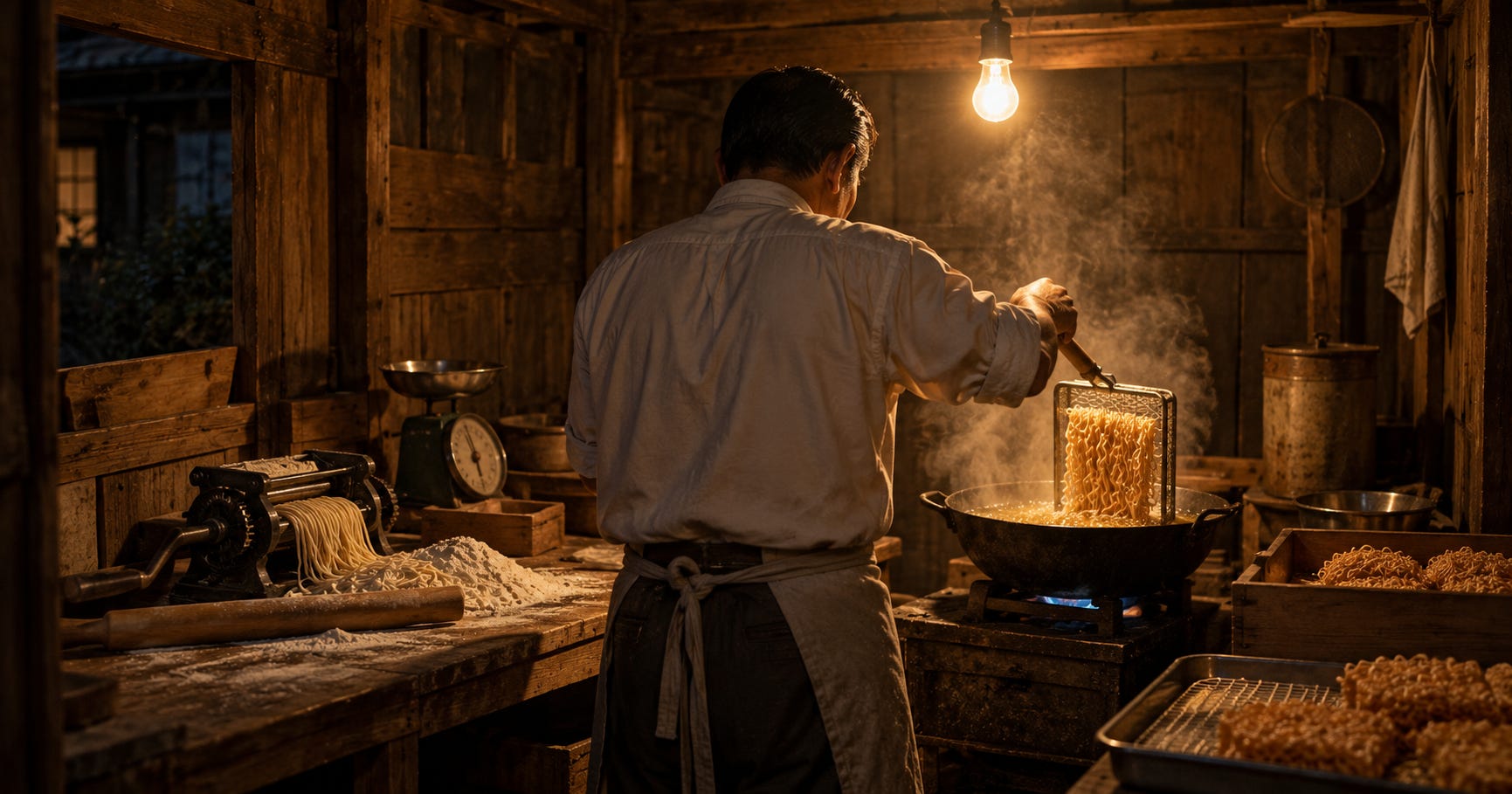
Behind the house in Ikeda, Ando built a small shed, about ten square meters, and equipped it with ordinary tools. His goal was ramen that could be made at home, quickly, with nothing but hot water.
When he told Masako what he was planning, she is said to have answered that he should become the best ramen maker in Japan.
He set himself five requirements. The noodles had to taste good enough that people would not get tired of them. They had to keep for a long time without spoiling. They had to be quick and easy to prepare. They had to be cheap. And they had to be safe and clean.
He was a complete amateur at making noodles. He worked alone, with no days off, sleeping about four hours a night. He made batch after batch, and threw batch after batch away. This went on for a year.
The hardest problem was drying the noodles so they would keep, and then bringing them back to life with hot water alone. The answer was in his own kitchen. One day he watched Masako frying tempura. When the battered food hit the hot oil, the water in the batter was driven out as steam.
Ando tried the same thing with noodles. He dunked them briefly in hot oil. The frying forced the moisture out, which dried the noodles and preserved them. Pour hot water over them, and in a couple of minutes they were soft again.
He was 48 years old, nearly broke, and working alone in a backyard shed. What he made there is now eaten more than 120 billion times a year.
Magic Ramen
On August 25, 1958, Ando’s product went on sale. He called it Chicken Ramen. The noodles were already flavored with chicken soup, so there was nothing to add but hot water. It was ready in two minutes. It was the first instant noodle in the world.
“In life, it’s never too late,” he said, looking back. “It took me forty-eight years to invent this product.”
It was not cheap. A serving cost 35 yen, at a time when a bundle of fresh udon noodles cost 6 yen. Wholesalers doubted anyone would pay it. They were wrong. People called it “magic ramen,” and before long trucks were lining up outside the factory to collect it. Ando’s company was named Nissin.
The timing helped. Japan’s first supermarket had opened the year before, and television was spreading into people’s homes. Ando sponsored programs and bought commercials. Five years after Chicken Ramen went on sale, it was bringing in 4.3 billion yen a year.
He was not finished. On a trip to the United States in 1966, Ando showed Chicken Ramen to supermarket buyers. They had no ramen bowls and no chopsticks. So they broke the noodles up, dropped them into paper cups, poured hot water over them, and ate with forks.
Ando saw that in other countries people would not eat ramen the way the Japanese did. The container had to be part of the product. He spent five years on the problem and tested around 40 different cups before settling on one made of foam.
Even then there was a snag. Dropping a brick of noodles into a narrow cup on a factory line did not work reliably. Ando’s answer was to turn the problem upside down. Instead of putting the noodles into the cup, the machine would lower the cup over the noodles.
On September 18, 1971, Nissin released Cup Noodles. Ando was 61. A cup cost 100 yen, four times the price of a packet of ordinary instant noodles.
It sold slowly at first, mostly to people who worked nights or outdoors. Nissin set up vending machines that dispensed hot water. Then, in February 1972, Japanese television broadcast live coverage of a long police standoff at a mountain lodge, in freezing weather. Viewers watched the police officers eating hot noodles out of cups. Sales took off. The next year Cup Noodles went on sale in the United States.
Ninety-Five
Ando kept going. In 2001, at the age of 91, he announced that Nissin would develop a noodle that could be eaten in space, and he led the project himself. The soup had to be thickened so it would not float away. The team made it in four flavors: soy sauce, curry, pork broth and miso.
In July 2005, the result flew aboard the space shuttle Discovery. The Japanese astronaut Soichi Noguchi became the first person to eat instant noodles in orbit. Ando was 95. “There’s no such thing as too late in life,” he said.
He died on January 5, 2007, at the age of 96. The day before, he had given a speech to Nissin’s employees at the company’s New Year gathering. The New York Times ran an editorial thanking him. It called him “Mr. Noodles.”
He left behind a collection of sayings. One of them was this: “If you fall, don’t just get up. Pick up some dirt while you’re at it.”
The World Instant Noodles Association, an industry group Ando himself founded, estimates that people around the world ate about 124 billion servings of instant noodles in 2025.
The Record Shows
What stays with me about Momofuku Ando is how late it all happened. He had already lived a full career’s worth of successes and failures by the time he lost everything, and most people in his place would have been thinking about how to get through the years they had left. He went out to the shed instead. He was a beginner at 47, an inventor at 48, an inventor again at 61, and he was working on food for astronauts in his nineties. We tend to tell the story of invention as a story about the young. This one belongs to a man who had already failed, and who decided the failure was not the end of his story.
Know someone who’d want to hear this one? Tap the restack arrows at the bottom of this post, or forward this email.
Sources
· Nissin Foods Group, “The Story of Momofuku Ando, Founder” (https://www.nissin.com/en_jp/about/founder/)
· Nippon.com, “Ando Momofuku: An Inventor Who Used His Noodle to Change Global Food Culture” (https://www.nippon.com/en/views/b07206/ando-momofuku-an-inventor-who-used-his-noodle-to-change-global-food-culture.html)
· CupNoodles Museum Osaka Ikeda, “About” (https://www.cupnoodles-museum.jp/en/osaka_ikeda/about/)
· World Instant Noodles Association, “Global Demand for Instant Noodles” (https://instantnoodles.org/en/noodles/demand/table/)
· Encyclopaedia Britannica, “Momofuku Ando” (https://www.britannica.com/biography/Momofuku-Ando)
· Wikipedia, “Momofuku Ando” (https://en.wikipedia.org/wiki/Momofuku_Ando)