


The Man
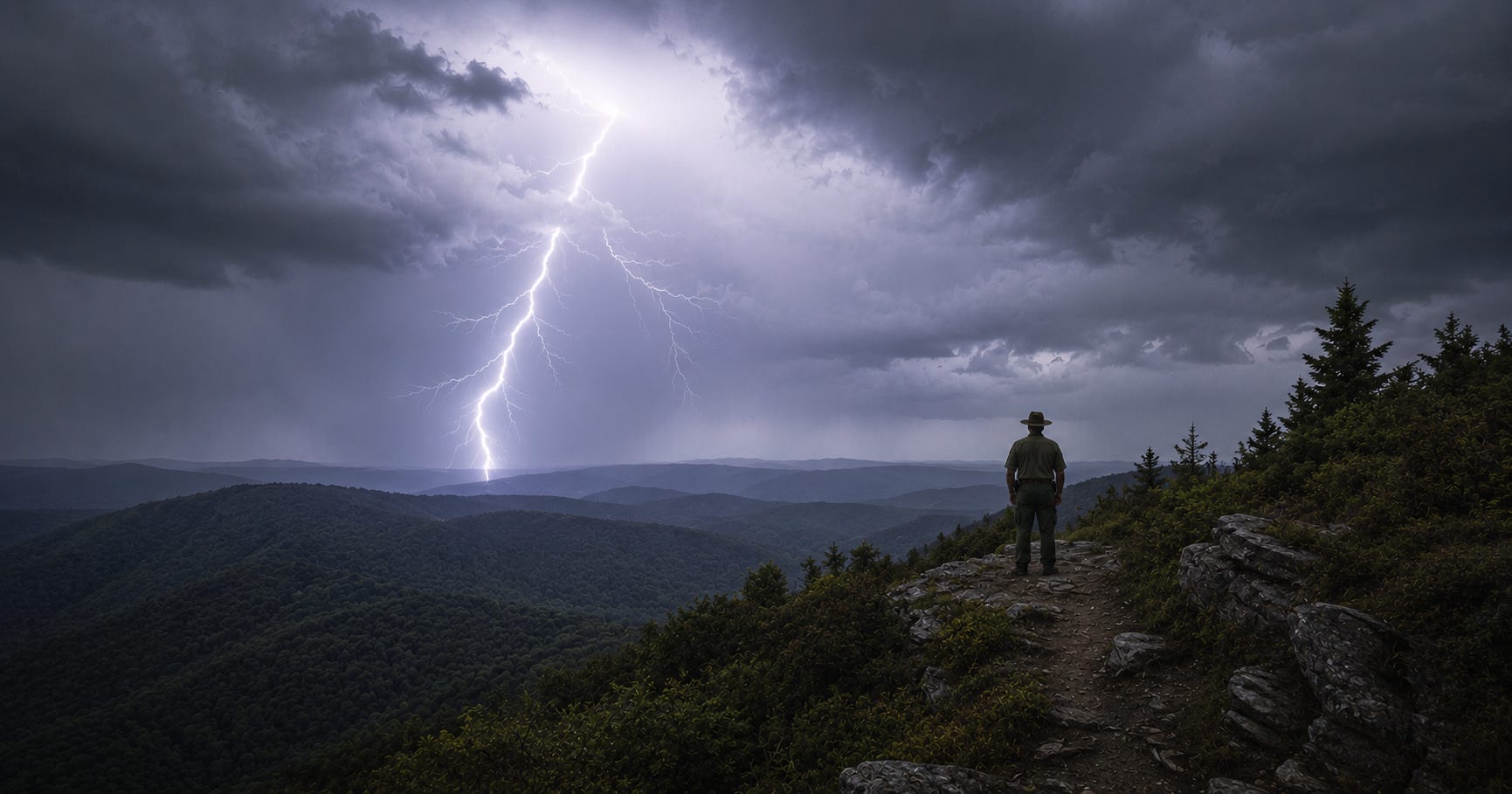
Roy Cleveland Sullivan was born in Greene County, Virginia in 1912, one of eleven children, and grew up in the shadow of the Blue Ridge Mountains. He was a big man — brawny, rugged-faced, the kind of person colleagues described as quietly competent and deeply devoted to his work. In 1936, he joined the National Park Service and began a thirty-six year career as a ranger in Shenandoah National Park, patrolling its forested ridges, staffing its fire lookout towers, maintaining its trails, and protecting its wildlife.
Shenandoah is beautiful. It is also, by virtue of its elevation and geography in the Blue Ridge Mountains, one of the most lightning-prone landscapes on the East Coast. This fact would come to define Roy Sullivan’s life in ways he never anticipated and never entirely understood.
Between 1942 and 1977, Roy Sullivan was struck by lightning seven separate times. He survived every one. Guinness World Records certified him as the human being struck by lightning more times than anyone else in recorded history. That record still stands.
The Seven Strikes
The first came in April 1942. Sullivan had taken shelter from a storm in a newly built fire lookout tower that had not yet been fitted with a lightning rod. The tower was struck eight times. He ran outside — and was struck just as he emerged, burning a half-inch strip down his right leg and blowing a hole through his boot.
The second came in July 1969, when lightning struck near his truck while he was driving through the park, leapt through the open window, and burned off his eyebrows. The third, in July 1970, hit a power transformer near his front yard and jumped to his left shoulder. The fourth, in spring 1972, struck while he was working inside a ranger station — it set his hair on fire. He ran to the bathroom but couldn’t fit his head under the tap. He used a wet towel.
By the fourth strike, Sullivan had begun to believe something was hunting him. He started carrying a can of water at all times in case his hair caught fire again. He developed the ability to sense atmospheric changes before storms arrived. When driving through the park during a thunderstorm, he would pull over and lie flat on the front seat until it passed.
The fifth strike, in August 1973, was perhaps the most dramatic. Sullivan spotted a storm cloud, drove away from it at speed, decided he was at a safe distance, stepped out of his truck — and was struck on the top of his head. The bolt set his hair alight, traveled down both arms, knocked him ten feet from the vehicle, and blew his left shoe off. He crawled back to his truck, poured his can of water over his burning head, and drove himself to the hospital.
The sixth, in June 1976, injured his ankle while he was out walking. The seventh and final strike came on June 25, 1977, while Sullivan was fishing. Lightning hit the top of his head, set his hair on fire again, traveled down and burned his chest and stomach. He turned toward his car. A bear emerged from the trees and began stealing trout from his fishing line. Sullivan grabbed a tree branch and drove the bear away — his hair still smoldering. He later noted it was the twenty-second time in his life he had struck a bear with a stick.
All seven strikes were officially documented by the superintendent of Shenandoah National Park, verified by doctors, and cross-referenced with hospital records. Roy Sullivan is not a legend. He is a Guinness World Record.
The Cost
What the record books don’t fully capture is what those thirty-five years did to Roy Sullivan beyond the physical damage — the lost toenail, the burned eyebrows, the singed hair, the permanent burn scars across his arms and chest.
People began to avoid him. Not out of cruelty, but out of the irrational but understandable fear that proximity to Roy Sullivan might be dangerous. He recalled walking through the park one afternoon with his chief ranger when lightning struck in the distance. “I’ll see you later,” the chief ranger said — and left. The park’s standing joke was that if you saw a dark cloud heading your way, you should get away from Roy Sullivan immediately.
Sullivan was saddened by the isolation. He had never been a fearful man — but after the fourth strike, he began to wonder if something was specifically and purposefully coming for him. He was a member of the Shenandoah Heights Baptist Church. He prayed. He kept working. He kept carrying his can of water.
His wife was also struck by lightning once, while hanging clothes in their back yard. Sullivan was helping her at the time but was unharmed. After that, he moved the family to separate rooms during storms — he sat alone in the kitchen, worried that his presence might draw lightning to the people he loved.
Roy Sullivan retired from Shenandoah National Park in 1977 — the same year as his seventh strike. On September 28, 1983, he died at his home at the age of seventy-one. Two of his ranger hats, both with lightning-scorched crowns, are on display at Guinness World Exhibit Halls in New York and South Carolina.
The Record Shows
Roy Sullivan’s story is easy to tell as a novelty — the man lightning couldn’t kill. But the deeper story is about a man who kept showing up. After the first strike, after the second, after his hair caught fire for the third time, after people started leaving rooms when he walked in — he put on his ranger hat and went back to the park he loved. He carried his can of water and he kept going. Not because he wasn’t afraid. Because the park was his and the work was his and nobody — not even the sky — was going to take that from him.
Sources
· Wikipedia — Roy Sullivan (en.wikipedia.org/wiki/Roy_Sullivan)
· Inside Nova — Shenandoah Recalls Park Ranger Struck Seven Times by Lightning (insidenova.com)
· Our Public Lands and Waters — The Spark Ranger: The Strange, Stoic Life of Shenandoah’s Roy Sullivan (ourpubliclandsandwaters.substack.com)
· National Parks Traveler — Shenandoah National Park Ranger Roy Sullivan Set the World Record for Being Hit by Lightning (nationalparkstraveler.org)
· Guinness World Records — Most Lightning Strikes Survived
If someone forwarded this to you and you’d like to receive Lost in the Record weekly, subscribe free at lostintherecord.substack.com
You don't see that kind of dedication that often today! The wildest part for me is that it was over 25 years before his first and second time being hit, but then he was hit 6 times in the span of 8 years.
Wow! What a story!