


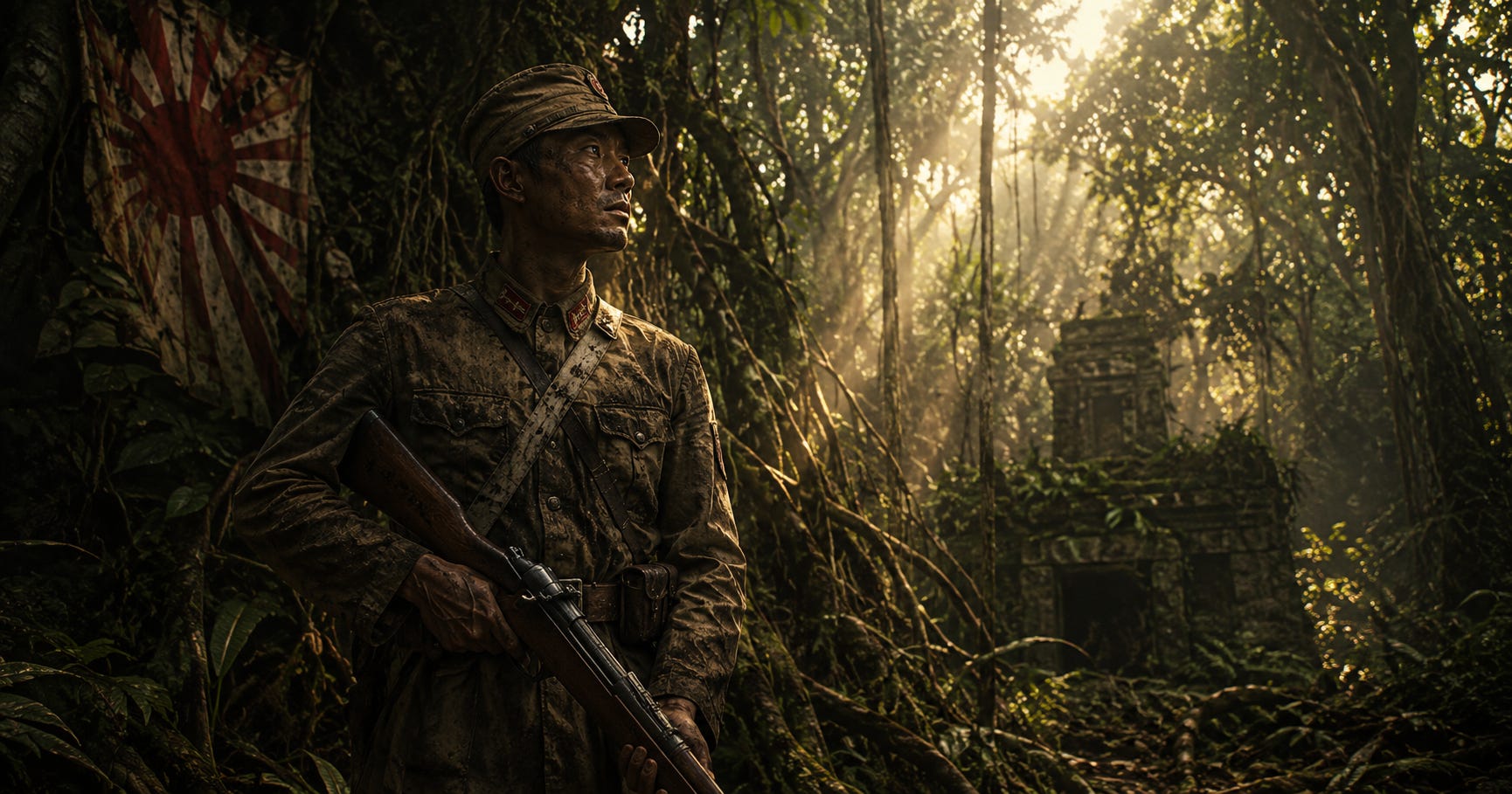
The Man
Hiroo Onoda wasn’t an ordinary soldier. Born in 1922 in rural Japan, he was the kind of young man his era was specifically designed to produce — disciplined, intensely loyal, and convinced that duty to the Emperor was the highest calling a person could answer. By the time he was conscripted into the Imperial Japanese Army in 1942, his three older brothers were already officers. Hiroo had been working at a trading company in China, learning English and Mandarin. The Army noticed.
He was selected for something far more elite than infantry training. He was sent to the Nakano Military School — a secretive facility that trained Japan’s best for guerrilla warfare, covert operations, propaganda, and intelligence work. Think of it as Japan’s wartime equivalent of special forces, combined with a spy academy. His orders upon graduation were unusual even by wartime standards: he was never to surrender, never to take his own life, and never to stop fighting — regardless of what he heard or saw — until a superior officer personally relieved him of duty.
In December 1944, Second Lieutenant Hiroo Onoda, age 22, was deployed to Lubang Island in the Philippines. His mission was to destroy the island’s airstrip and harbor ahead of the Allied invasion. He arrived to find officers who outranked him and refused to let him execute his orders. Within months, American forces took the island. Most Japanese soldiers surrendered or died. Onoda retreated into the mountains with three other holdouts and disappeared into the jungle.
The 29 Years
What followed is one of the most staggering stories of the 20th century — not because of heroism, exactly, but because of what total commitment to an idea actually looks like when it outlasts the idea itself.
For nearly three decades, Onoda and his dwindling band of soldiers lived as ghosts. They moved camp every few days, leaving no trace. They survived on bananas, coconuts, and cattle and rice stolen from local farmers. They maintained their weapons with obsessive care — when Onoda finally emerged in 1974, his Arisaka Type 99 rifle was still in perfect working order. They occasionally exchanged gunfire with Philippine police and local villagers, whom they believed to be enemy combatants. Over the years, they killed an estimated 30 civilians. They did not believe they were killing civilians. They believed they were fighting a war.
Leaflets were dropped from aircraft announcing Japan’s surrender. Onoda read them and concluded they were Allied propaganda — the printing errors alone convinced him they were fakes. His own family sent letters. He suspected a trick. One of his companions, Private Akatsu, surrendered to Filipino forces in 1950. Onoda interpreted this as a capture, not a choice. Corporal Shimada was shot dead by island police in 1954. Private Kozuka was killed in a police shootout in 1972 — just two years before the end.
After Kozuka’s death, Onoda fought on alone for two more years. One man. One rifle. One jungle island. One war that had been over for nearly three decades.
The Moment of Truth
In 1974, a young Japanese adventurer named Norio Suzuki decided he wanted to find Onoda — not as a government mission, not as a military operation, just personal curiosity. He trekked into the jungle and found him within days. Onoda was polite, even warm. But he would not surrender to a civilian. He would only stand down if his commanding officer ordered it in person.
Suzuki returned to Japan with photographs as proof, and the Japanese government tracked down Major Yoshimi Taniguchi — who had long since left the military and was, of all things, working as a bookseller. Taniguchi flew to Lubang, walked into the jungle, and on March 9, 1974, formally read Onoda his relief orders.
Onoda wept. Uncontrollably. For a man trained to feel nothing but mission, it was the only appropriate response to having his entire world dissolve in a single sentence.
He emerged from the jungle the next day still wearing his original Imperial uniform. He carried his functioning rifle, 500 rounds of ammunition, several hand grenades, and a dagger his mother had pressed into his hands in 1944 — to use on himself if he was ever captured. He had carried it, untouched, for 30 years.
He formally surrendered his sword to Philippine President Ferdinand Marcos, who pardoned him. Japan welcomed him home to a crowd of 8,000 people. When asked what had gone through his mind during those 29 years, Onoda answered without hesitation: “Nothing but accomplishing my duty.”
What Came After
Onoda struggled deeply with modern Japan. He felt alienated from a country he no longer recognized — one he saw as having abandoned the values that had sustained him through three decades of jungle survival. Within a year, he moved to Brazil, where he became a cattle rancher. He married in 1976. In the 1980s, he returned to Japan and founded the Onoda Nature School, teaching children wilderness survival and self-reliance. He donated $10,000 to a school on Lubang Island — the same island where he had spent his hidden war.
He appeared on American television in February 1975, on The Mike Douglas Show, discussing his thirty years with characteristic calm. He published a memoir, No Surrender: My Thirty-Year War, which became a bestseller. He died in Tokyo in January 2014, at the age of 91.
He never fully apologized for the civilians killed during his jungle campaign. He saw no reason to. In his mind, he had been at war the entire time. Every action had been legitimate. Every order had been followed.
The Record Shows
Hiroo Onoda was not a madman or a fool. He was the perfect product of his era — a system that valued obedience above survival, loyalty above reason, and duty above everything else. The tragedy isn’t that he kept fighting. It’s that the world that made him that way was gone before he ever reached the jungle. His 29 years weren’t stubbornness. They were a man living faithfully inside a reality that had already ceased to exist. Most of us have never been tested like that. Some of us, if we’re honest, are still fighting wars that ended long ago too — just quieter ones.
Sources
· Wikipedia — Hiroo Onoda (en.wikipedia.org/wiki/Hiroo_Onoda)
· History Hit — Hiroo Onoda: The Japanese Soldier Who Refused to Surrender (historyhit.com)
· ExplorersWeb — The Japanese Soldier Who Refused to Believe the War Was Over (explorersweb.com)
· Onoda, Hiroo. No Surrender: My Thirty-Year War. Kodansha International, 1974.
· The Mike Douglas Show, February 14, 1975 (televised interview)
If someone forwarded this to you and you’d like to receive it weekly, subscribe free at lostintherecord.substack.com
What a fantastic story of loyalty, dedication & courage!