


The Setup
January 15, 1919 was an unusually warm day in Boston — temperatures had climbed above forty degrees after weeks of bitter cold, and the North End neighborhood was alive with the ordinary sounds of a Wednesday afternoon. Laborers worked at the paving yard. Horses pulled carts along Commercial Street. Children on their lunch break from school wandered the streets near the waterfront. At Engine 31 firehouse, a group of men finished their lunch and settled in for a friendly card game.
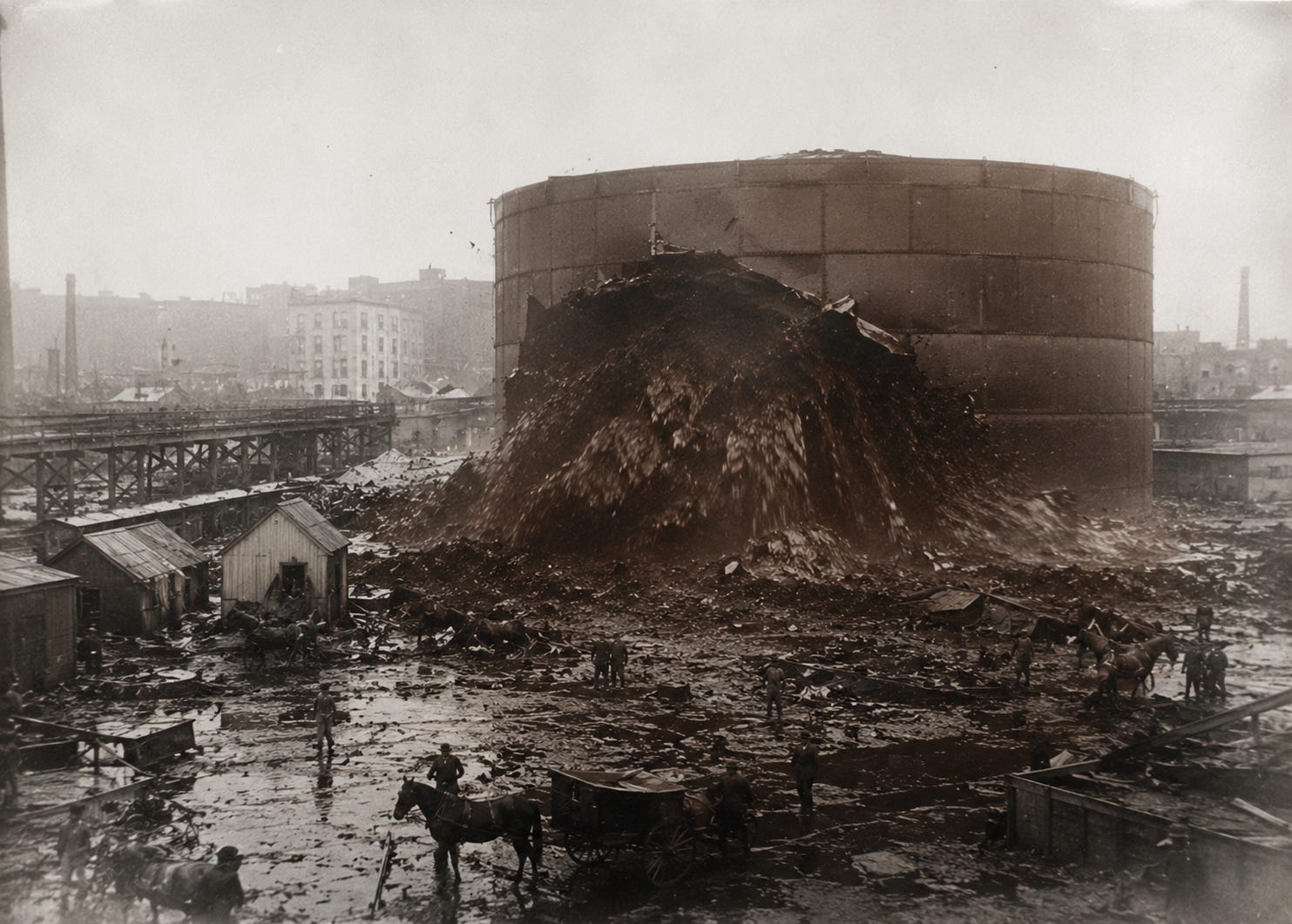
Standing over all of them, fifty feet tall and ninety feet wide, was a steel storage tank owned by the Purity Distilling Company — a subsidiary of United States Industrial Alcohol. The tank held 2.3 million gallons of raw molasses, shipped in from Cuba, Puerto Rico, and the West Indies, to be distilled into industrial alcohol for munitions manufacturing during the First World War. The war had ended two months earlier. The tank was still full.
Local residents had complained about the tank for years. It leaked constantly — so much so that neighborhood children collected the dripping molasses in pails to take home. When residents formally complained, the company’s solution was to paint the tank brown to disguise the seepage. The man who had supervised its construction could not read blueprints. No licensed engineer or architect had ever assessed its structural integrity. Its steel walls were less than an inch thick and mixed with too little manganese, making them dangerously brittle in cold temperatures.
At 12:30 in the afternoon, the tank made a sound — a deep metallic groan, then a roar — and split open.
The Wave
The phrase “slow as molasses” exists for a reason. Molasses is thick, dense, and viscous — the very symbol of unhurried movement. What happened on Commercial Street on January 15, 1919 had nothing to do with that molasses.
Scientists who later analyzed the disaster determined that molasses is 1.5 times denser than water. When 2.3 million gallons of it are released at once from a fifty-foot tank, the potential energy stored in that mass converts instantly to kinetic force. For the first sixty to ninety seconds, viscosity is irrelevant. Inertia takes over entirely.
The wave that hit Commercial Street was twenty-five feet high, one hundred and sixty feet wide, and traveling at thirty-five miles per hour. A Boston police officer at a nearby call box heard the tank burst and managed to radio headquarters: “Send all available rescue vehicles and personnel immediately — there’s a wave of molasses coming down Commercial Street.” No one at headquarters knew what to say to that.
The Boston Globe reported: “There was no escape from the wave. Caught, human being and animal alike could not flee. Running in it was impossible. Snared in its flood was to be stifled. Once it smeared a head — human or animal — there was no coughing off the sticky mass.”
The wave ripped Engine 31 firehouse clean off its foundation. It knocked an elevated train off its tracks. It demolished buildings, overturned railcars, and swept horses and people alike into its current. Martin Clougherty, a barman who had been sleeping in his third-floor bedroom overlooking the tank, woke up submerged in molasses. His bed frame was floating. He used it as a raft to rescue his sister. His mother and younger brother did not survive.
Two children — ten-year-old Pasquale Iantosca and ten-year-old Maria Distasio — had been out collecting firewood for their families when the wave hit. Pasquale’s father watched from his apartment window as the children disappeared into the flood. Twenty-one people died. One hundred and fifty were injured. Twelve horses perished. Rescue workers who rushed to help found themselves sinking into the molasses and had to be pulled out by colleagues spreading ladders across the surface to distribute their weight.
The Aftermath
Cleanup took weeks. Over three hundred workers converged on Commercial Street. Standard tools were useless — the molasses coated everything and made debris immovable. Workers eventually discovered that saltwater broke down the syrup and began pumping it in from Boston Harbor. The waters of the harbor remained brown until summer. Residents of the North End reported that on hot days, for decades afterward, the neighborhood still smelled faintly of molasses.
United States Industrial Alcohol initially blamed anarchists for the disaster — a plausible claim in an era when bombings were common — but a five-year court case determined the cause was straightforwardly structural failure. The tank’s walls were too thin. The steel was the wrong composition. No qualified engineer had ever signed off on it. The company paid the equivalent of roughly fifteen million dollars in today’s money to victims and their families.
More significantly, the disaster directly changed American construction law. Massachusetts passed new regulations requiring that all major construction projects be overseen by a licensed architect and civil engineer. The era of building large industrial structures with unqualified supervisors who couldn’t read blueprints was over — in Boston, at least.
The concrete base of the molasses tank still sits approximately twenty inches below the surface of a baseball diamond at Langone Park in Boston’s North End. On the one hundredth anniversary of the disaster in 2019, attendees stood in a circle marking the edge of where the tank once stood and read aloud the names of the twenty-one people who died there on an unusually warm January afternoon.
The Record Shows
The Great Molasses Flood is easy to treat as a curiosity — a bizarre historical footnote that sounds more like a Monty Python sketch than a genuine tragedy. But twenty-one people died, including two ten-year-old children collecting firewood. They died because a company built a tank it knew was leaking, painted it brown to hide the evidence, employed a supervisor who couldn’t read blueprints, and calculated that fixing the problem was less profitable than ignoring it. The molasses was unusual. The negligence was not. It never is.
Sources
· Wikipedia — Great Molasses Flood (en.wikipedia.org/wiki/Great_Molasses_Flood)
· History.com — The Great Molasses Flood of 1919 (history.com)
· Boston.gov — 100 Years Ago Today: Molasses Crashes Through Boston’s North End (boston.gov)
· NBC News — The Great Boston Molasses Flood of 1919 (nbcnews.com)
· Puleo, Stephen. Dark Tide: The Great Boston Molasses Flood of 1919. Beacon Press, 2003.
If someone forwarded this to you and you’d like to receive Lost in the Record weekly, subscribe free at lostintherecord.substack.com
While we clearly hate them when constructing anew or adding onto an existing structure, building codes exist for a reason. This is a prime example.
As someone who hates molasses, what a terrible way to go. At least if it was vodka or rum, they'd be able to say that at least I died happy.
Absolutely mind blowing 🤯. I'd never have believed it could happen. Imagining dieing that way...what an awful & terrifying experience...to never come back from. 😢 💔 Sad that it was entirely preventable. 😥