


The Beginning
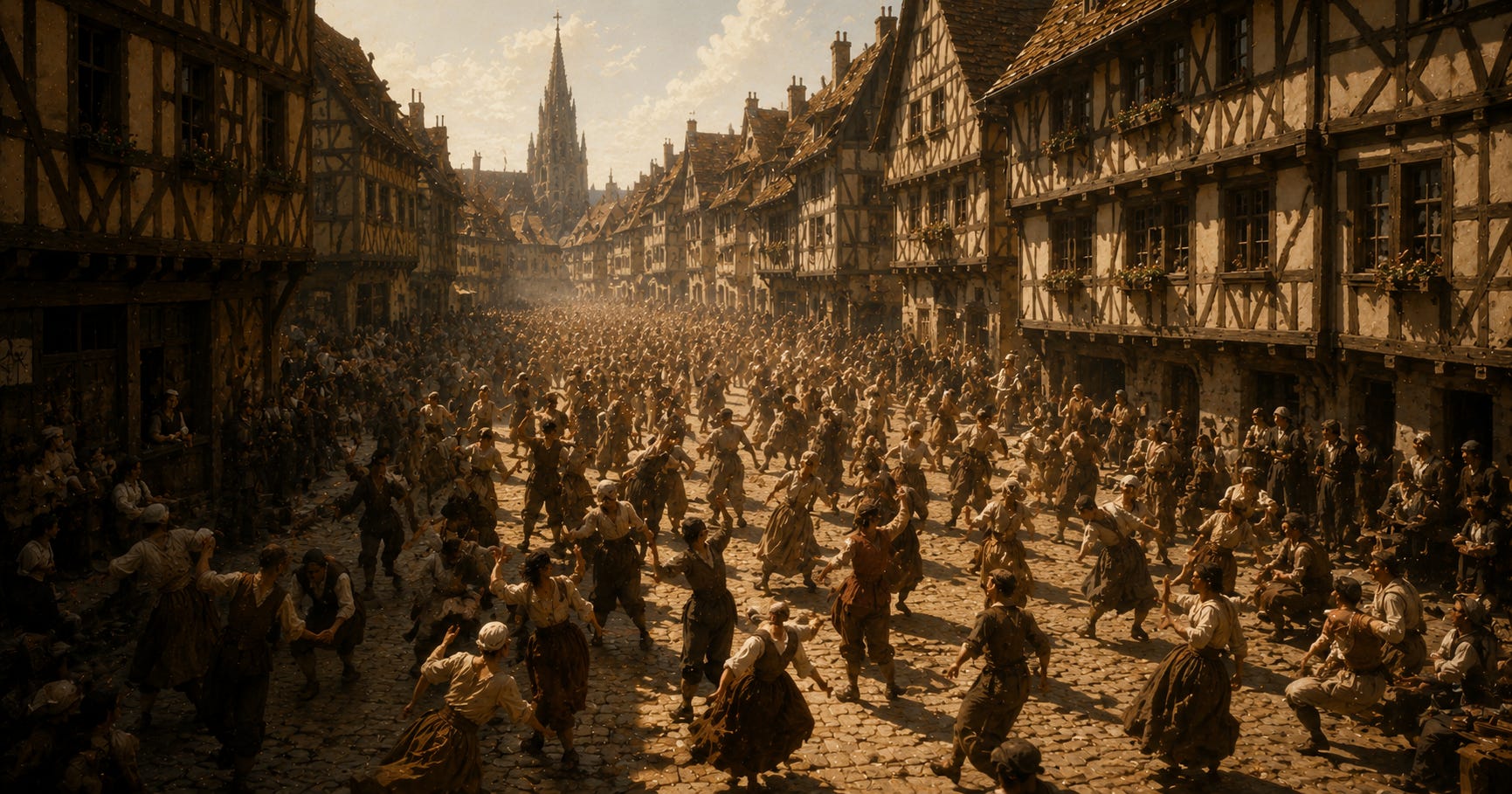
On July 14, 1518, on a narrow cobblestone street outside her half-timbered home in Strasbourg — then a city in the Holy Roman Empire, now in northeastern France — a woman known as Frau Troffea stepped outside and began to dance.
This was not celebratory dancing. There was no music. There was no occasion. Frau Troffea twisted and convulsed and jerked through the summer heat, ignoring her husband’s increasingly desperate pleas to stop, dancing until she collapsed from exhaustion. Then she slept. Then she got up and danced again — on feet that had become bloody and swollen from the day before.
She danced for six days straight.
By the end of the first week, approximately thirty other people had joined her. Not because they wanted to. Contemporary accounts describe them as weeping, calling out for help, begging to be stopped — and continuing to dance. By the end of August, as many as four hundred people had been seized. Some accounts suggest that during the peak of the mania, people were dying of heart attacks, exhaustion, and heatstroke at a rate of several per day.
The city of Strasbourg had a dancing plague.
The Response
The authorities of Strasbourg — civic leaders and physicians — convened to address the crisis and reached a conclusion that, by the standards of the era, made a certain kind of sense. The dancing was caused by overheated blood, they decided. The cure was more dancing. If the afflicted could dance until the fever broke, they would recover.
The city hired musicians. It cleared public spaces — guildhalls, the grain market, an open-air stage near the horse market. It brought in professional dancers to dance alongside the afflicted and keep the energy going. Pipes, drums, and horns played around the clock in the July heat as hundreds of people danced involuntarily under the blazing sun.
This did not help. The dancing spread. The deaths continued.
The authorities reversed course. They banned the music, shut down the stages, and sent the most severely afflicted to a shrine dedicated to Saint Vitus — the Catholic saint whom many 16th-century Europeans believed could curse people with uncontrollable dancing as divine punishment. At the shrine, the dancers were given red shoes and made to perform specific religious rituals in hopes of appeasing the saint.
By September 1518, the dancing had stopped — as suddenly and mysteriously as it had begun. Frau Troffea and her fellow dancers returned to their lives. No authoritative record of the total death count was kept. Historians estimate somewhere between a handful and several hundred people died. The city filed it under resolved and moved on.
The Theories
Five hundred years later, we still don’t know what caused the Dancing Plague of 1518. The theories are numerous and none is conclusive.
The most widely accepted modern explanation is mass psychogenic illness — what used to be called mass hysteria. Historian John Waller, who has studied the event extensively, argues that Strasbourg in 1518 was a city under extraordinary collective stress. Three years of famine had preceded that summer. Plague was present. Smallpox was present. The printing press was reshaping society. Martin Luther had just challenged Catholic doctrine the year before. Religious anxiety was intense. And there was a widespread local belief that Saint Vitus could inflict dancing madness as a curse on those who failed to properly honor him.
In this context, Waller argues, one person’s breakdown could propagate through a traumatized community like a contagion — not because anyone chose to dance, but because the belief system of the era made involuntary dancing a plausible and culturally legible way for extreme stress to manifest. The body expressed what the mind could not contain.
Other theories include ergot poisoning — a toxic fungus that grows on damp rye grain and can cause hallucinations and convulsions. Some historians have proposed religious cult activity. Others note that similar dancing manias occurred across Europe between the 10th and 17th centuries — at least twenty comparable episodes — and that whatever caused them, they seem to have disappeared entirely after the 17th century, as if the cultural conditions that generated them had simply ceased to exist.
The 1518 Strasbourg outbreak is the best documented of all of them — partly because the printing press, newly present in the city, generated more written records than earlier episodes had. It is also, as far as historians are aware, the last major outbreak of its kind ever recorded in Europe.
The Record Shows
The Dancing Plague of 1518 is one of those events that resists the comfortable explanations history usually provides. We want a villain, a disease, a cause we can name and file away. What we have instead is a city full of people who couldn’t stop dancing, a set of authorities who made it worse by hiring musicians, and a mystery that five centuries of scholarship has not definitively solved. Whatever happened in Strasbourg that summer, it happened to real people who were frightened and in pain and could not stop moving. That part is not strange at all. That part is very human. The dancing is what we don’t understand.
Sources
· Wikipedia — Dancing Plague of 1518 (en.wikipedia.org/wiki/Dancing_plague_of_1518) · National Geographic — What Caused Strasbourg’s Dancing Plague of 1518? (nationalgeographic.com) · History.com — What Was the Dancing Plague of 1518? (history.com) · Britannica — Dancing Plague of 1518 (britannica.com/event/dancing-plague-of-1518) · The Public Domain Review — The Dancing Plague of 1518 (publicdomainreview.org)
If someone forwarded this to you and you’d like to receive Lost in the Record weekly, subscribe free at lostintherecord.substack.com