


The Plan
In August 1914, as the First World War erupted across Europe, a ship called the Endurance quietly left London bound for Antarctica. It carried twenty-eight men — twenty-seven crew plus expedition leader Ernest Shackleton — and an ambition that had already consumed years of Shackleton’s life: to be the first to cross the Antarctic continent on foot, from the Weddell Sea to the Ross Sea.
Shackleton had come agonizingly close to the South Pole before — turned back just 97 miles short on a previous expedition by dwindling food supplies. He was determined to leave his mark on Antarctica permanently. The expedition had received over five thousand applications. Winston Churchill himself had directed the Endurance to proceed despite the outbreak of war.
The ship’s name came from Shackleton’s family motto: Fortitudine Vincimus. Through endurance we conquer.
It would need to.
The Ice
The Endurance entered the Weddell Sea in December 1914. The pack ice — the vast barrier of frozen sea that surrounds Antarctica — was unusually thick that year. For several weeks the ship picked its way carefully south through gaps in the ice. Then, on January 19, 1915, the gaps closed. A gale pressed the pack hard against the shore and the floes locked tight. The Endurance was trapped.
She never moved under her own power again.
For ten months, the ship drifted locked in the ice — carried north by the slow movement of the pack, the crew living aboard her, waiting for a thaw that never came. Shackleton kept his men occupied with work, sports, sing-alongs, and evening entertainment. He understood instinctively that morale was survival. He distributed the ship’s chores equally across officers and sailors, ate with his crew, led the jokes and games after dinner. He had hired his men partly based on their temperament, sensing that character under pressure mattered more than technical skill.
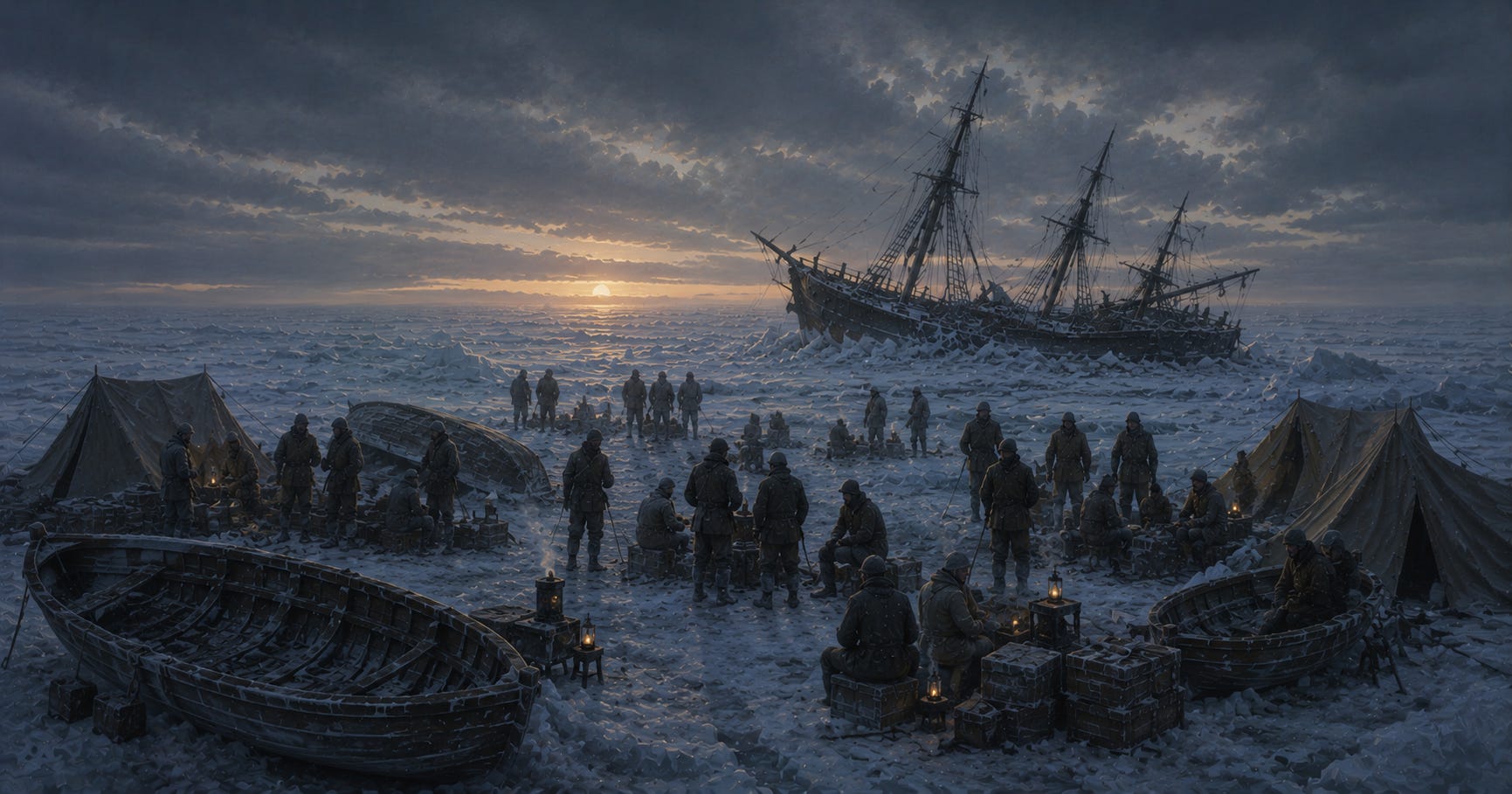
Then in October 1915 the ice shifted again — but not in their favor. The pressure of the moving pack began to squeeze and crush the hull. The wood groaned and split. Freezing water rushed in. On October 27, Shackleton gave the order: abandon ship.
Twenty-eight men stepped off the Endurance onto the ice with three small lifeboats, their remaining supplies, and no rescue coming. Twenty-five days later, what remained of the ship convulsed and disappeared beneath the surface. The Endurance was gone.
Shackleton gathered his men. “Ship and stores have gone,” he told them. “So now we’ll go home.” He did not explain how. He had no plan yet. But he said it with sufficient certainty that the men believed him.
The Journey
For five months the crew camped on drifting ice floes — eating seals and penguins, surviving Antarctic winter, managing fear and boredom and cold with extraordinary discipline. When the ice finally began to break up in April 1916, they launched their three small lifeboats into the Southern Ocean and sailed for the nearest land — the bleak, uninhabited Elephant Island, 346 miles away.
It was the first time any of them had stood on solid ground in 497 days.
But Elephant Island was not a rescue. No ship would ever find them there by accident. Shackleton made the decision that would define his legacy: he would sail the smallest of the three lifeboats — the 22-foot James Caird — 800 miles across the most dangerous stretch of ocean on earth to the whaling station at South Georgia, where he could raise a rescue party.
He took five men. The crossing took seventeen days across seas that regularly produce the largest waves on the planet. Navigator Frank Worsley guided them by sextant — a nearly impossible feat in those conditions — and they arrived at South Georgia’s southern coast on May 10, 1916. The whaling station was on the other side of the island, separated by an uncharted mountain range that no one had ever crossed.
Shackleton, Worsley, and one other man crossed it on foot in thirty-six hours. They arrived at the Stromness whaling station covered in frost and barely recognizable as human. The station manager — who had known Shackleton for years — reportedly did not recognize him at first.
Three rescue attempts for the men left on Elephant Island were turned back by ice. On August 30, 1916 — 105 days after Shackleton had left them — the fourth attempt broke through. Every man was alive. Shackleton had not lost a single crew member in twenty-two months stranded in Antarctica.
The crossing of Antarctica — the expedition’s entire original purpose — was never attempted. Shackleton died of a heart attack in 1922 at forty-seven, back in the waters near South Georgia, on his fourth Antarctic expedition. He was buried there, at his wife’s request. She said the South was where he truly belonged.
The Record Shows
Shackleton failed at everything he set out to do. He never crossed Antarctica. He never reached the South Pole. His ship sank. His expedition achieved none of its stated objectives. What he did instead was keep twenty-seven men alive for twenty-two months in one of the most hostile environments on earth, through the force of his presence, his judgment, and his refusal to accept that any of them were going to die. History is full of people who succeeded at what they planned. Shackleton is remembered for what he did when the plan collapsed entirely. The family motto turned out to be right. It just didn’t mean what anyone expected.
Sources
· Wikipedia — Ernest Shackleton (en.wikipedia.org/wiki/Ernest_Shackleton)
· History.com — The Stunning Survival Story of Ernest Shackleton and His Endurance Crew (history.com)
· Britannica — Ernest Shackleton (britannica.com/biography/Ernest-Henry-Shackleton)
· Aurora Expeditions — Sir Ernest Shackleton’s Endurance Expedition Timeline (aurora-expeditions.com)
· Shackleton, Ernest. South: The Story of Shackleton’s Last Expedition 1914-17. Heinemann, 1919.
If someone forwarded this to you and you’d like to receive Lost in the Record weekly, subscribe free at lostintherecord.substack.com