

He Was the Wealthiest Person in History. On His Way to Mecca, He Accidentally Crashed the Egyptian Economy.
He gave away gold like it was nothing. An empire's economy paid for it for the next twelve years.

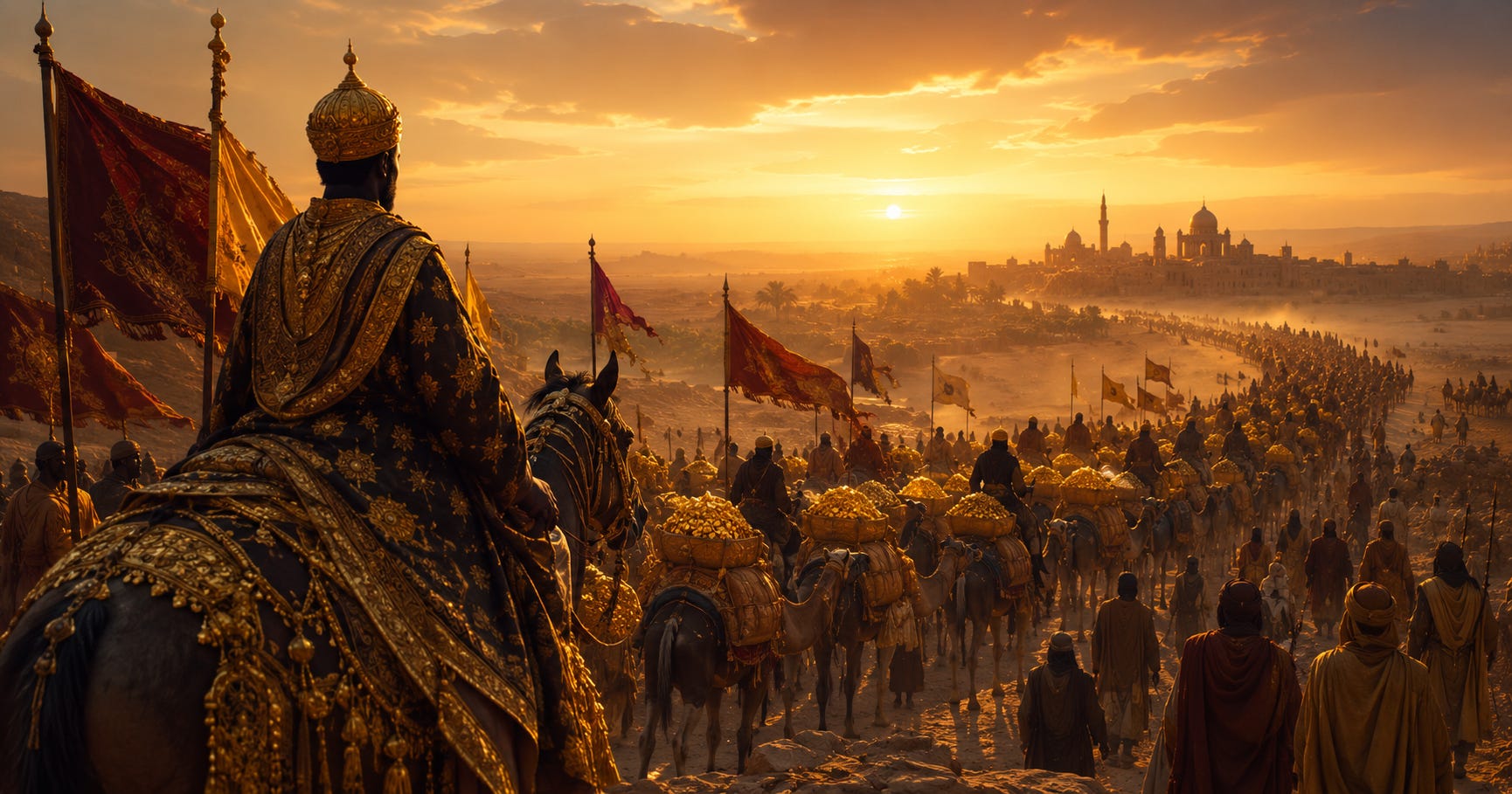
The Emperor
Mansa Musa became the ninth emperor of the Mali Empire around 1312. “Mansa” was a title — roughly equivalent to emperor or sultan — and Musa was the man who wore it at the height of Mali’s power and reach. His empire stretched across what is now Mali, Guinea, Senegal, Mauritania, and the Gambia — a vast territory positioned at the center of the most lucrative trade routes in West Africa, controlling the flow of gold from the south and salt from the north.
There is genuine historical debate about how to calculate the wealth of medieval rulers whose personal fortunes were inseparable from the resources of their entire state. But contemporary Arabic chroniclers — serious scholars who had no particular reason to exaggerate on Musa’s behalf — described his wealth in terms that suggested it exceeded anything they had previously encountered or imagined. Time magazine has noted simply: “There’s really no way to put an accurate number on his wealth.” Modern estimates, for whatever they are worth, place his net worth at the equivalent of roughly $400 billion in today’s terms — more than four times the wealth of King Solomon, who was previously considered the benchmark for incomprehensible riches.
In 1324, Mansa Musa did what all devout Muslims are expected to do at least once in their lives if they are able: he made the Hajj — the pilgrimage to Mecca. The question of whether Mansa Musa was “able” to make the journey did not arise. The question was only how.
The Caravan
He traveled with 60,000 people. His personal retinue included 12,000 servants, all dressed in brocade and Persian silk. Five hundred heralds walked directly before him, each carrying a six-pound staff of solid gold. Eighty camels carried between 50 and 300 pounds of gold dust each. There were hundreds of additional camels loaded with food, textiles, and supplies. Horse riders waved the huge red and gold banners of the Mali Empire. A mobile mosque was constructed each evening so the emperor could pray.
The caravan crossed the Sahara and arrived at the outskirts of Cairo in July 1324. They camped for three days by the Pyramids of Giza before crossing the Nile into the city. Cairo’s population at the time was approximately one million people. It had never seen anything like this.
Mansa Musa met with the Mamluk sultan al-Nasir Muhammad — though the meeting nearly became a diplomatic incident, because Musa was so absorbed in his religious observances that he initially declined to formally prostrate himself before the Egyptian ruler, as protocol required. He was persuaded to pay a brief courtesy visit and the awkwardness was smoothed over.
Then he started giving away gold.
Arab historian Shihab al-Umari, who visited Cairo twelve years after Musa’s passage, wrote that the emperor “flooded Cairo with his benefactions. He left no court official nor holder of a royal office without the gift of a load of gold. They spent gold until they depressed its value in Egypt and caused its price to fall.”
The Crash
What happened in Cairo in the summer of 1324 was, in modern economic terms, hyperinflation triggered by a sudden massive increase in the gold supply. Mansa Musa and his entourage distributed so much gold — through direct gifts, through purchases made at any asking price, through donations to mosques and to the poor — that the metal’s value in Cairo collapsed by approximately twenty percent relative to silver. Merchants who held gold savings found their wealth suddenly worth a fraction of what it had been. Prices for goods soared as the economy tried to adjust to the new reality.
The Egyptian economy did not fully recover for twelve years.
What makes the story stranger still is what Mansa Musa did on his return journey. He appears to have understood — or been advised — what his generosity had caused. He went to Cairo’s moneylenders and borrowed back as much gold as he could, at substantial rates of interest, deliberately removing currency from circulation to relieve the inflationary pressure he had created. Whether this represented genuine economic insight or desperate damage control has been debated by historians ever since. Either way, it is one of the earliest documented instances of a foreign sovereign attempting deliberate monetary intervention in another country’s economy.
The story of Musa’s pilgrimage spread across the Muslim world and beyond. European cartographers — who had previously left sub-Saharan Africa as blank space on their maps, populated with speculation and myth — were forced to reckon with what lay south of the Sahara. The 1375 Catalan Atlas, one of the most important medieval maps ever produced, features Mansa Musa prominently: seated on a throne, holding a gold orb and scepter, with text identifying him as the richest and most noble king in all the land. The Portuguese expeditions that began exploring the West African coast in the following century were motivated partly by the legend that this atlas helped create.
The Record Shows
Mansa Musa is the only person in recorded history to have single-handedly crashed another country’s economy through sheer generosity. He didn’t invade Egypt. He didn’t threaten it. He simply passed through it on his way to Mecca, gave away gold the way most people give away pleasantries, and left behind twelve years of economic disruption. His pilgrimage also forced Europe to acknowledge that unimaginable wealth and sophisticated civilization existed in places it had chosen to dismiss. He accomplished all of this on a religious journey he was required to make anyway. Whatever else you say about Mansa Musa, nobody has ever been more expensive to have as a houseguest.
Sources
· Wikipedia — Mansa Musa (en.wikipedia.org/wiki/Mansa_Musa)
· Britannica — Musa I of Mali (britannica.com/biography/Musa-I-of-Mali)
· World History Encyclopedia — Mansa Musa I: The Richest Man in History? (worldhistory.org)
· University of Oxford — Mansa Musa I of Mali: Gold, Salt, and Storytelling (globalcapitalism.history.ox.ac.uk)
· Ancient Origins — Mansa Musa, History’s Richest Man, Wrecked Egypt’s Economy (ancient-origins.net)
If someone forwarded this to you and you’d like to receive Lost in the Record weekly, subscribe free at lostintherecord.substack.com