


The Night
It was just past midnight on September 26, 1983, when the sirens started.
Lieutenant Colonel Stanislav Petrov was forty-four years old, a software engineer by training, and the duty officer on the night shift at Serpukhov-15 — a top-secret Soviet bunker sixty kilometers south of Moscow that housed the command center for the USSR’s nuclear early warning system. The system was called Oko. Its job was simple and terrifying: watch the skies above American missile fields and send word the moment anything launched.
Petrov was filling in that night for a colleague who had called in sick. He had helped write the code that ran the system. He knew its capabilities better than almost anyone — and he knew its flaws.
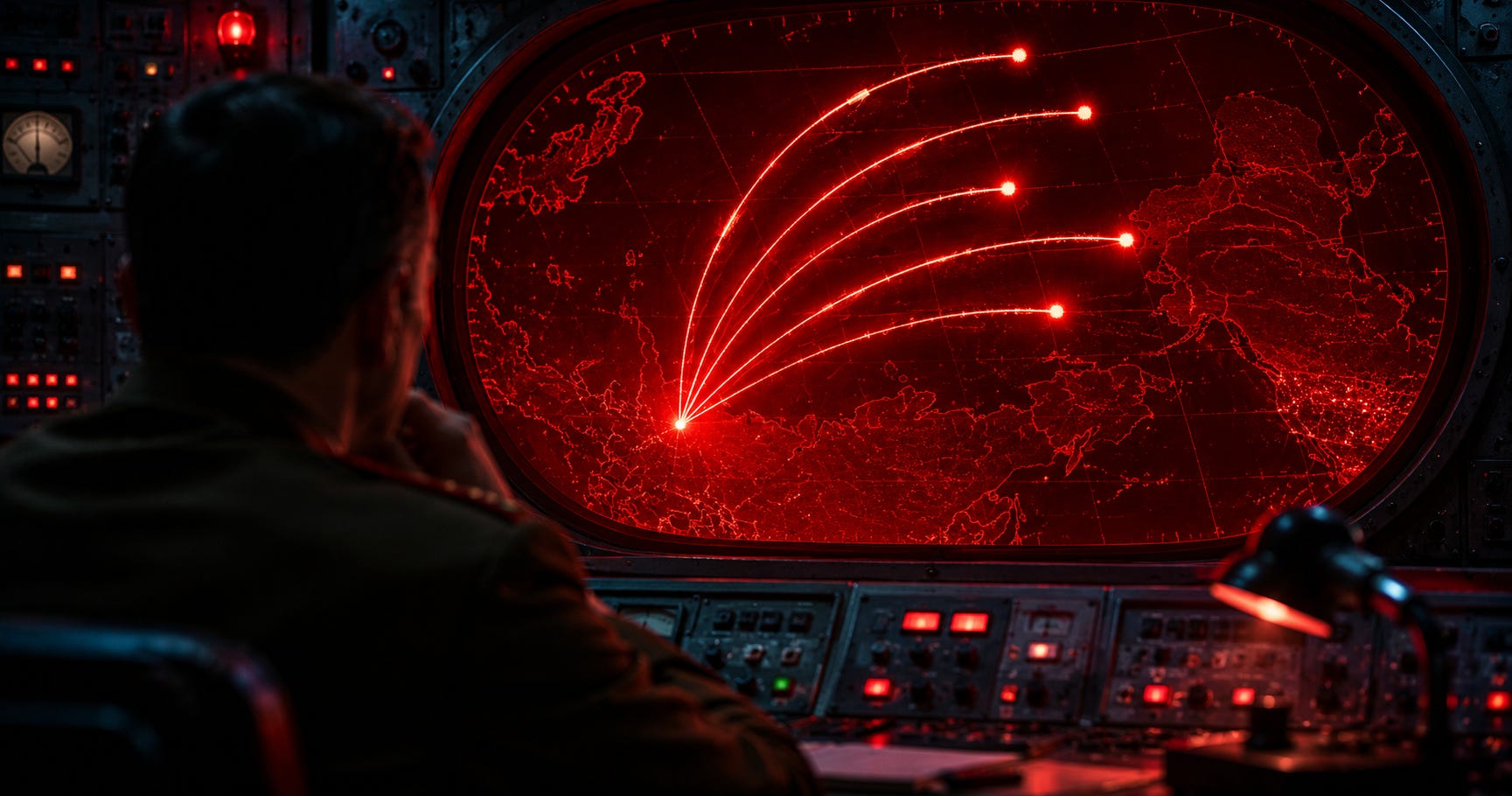
Shortly after midnight, a panel on the wall lit up in bright red letters: LAUNCH.
One American intercontinental ballistic missile, the system said, was inbound. Then four more appeared behind it. The computer rated its own confidence as “high reliability.” The alarm was deafening. Petrov’s subordinates turned to him, waiting for his next move. Protocol was clear: report immediately up the chain of command. His superiors would escalate to the general staff. The general staff would escalate to the Kremlin. And the Kremlin — operating under a doctrine of launch-on-warning, meaning the Soviet Union would fire back before enemy missiles could land — would almost certainly retaliate.
Petrov had ten minutes to decide whether that chain of events would begin.
The Decision
He sat very still and thought.
Something wasn’t right. Everything he knew about American nuclear strategy told him that a first strike would be massive — hundreds of missiles launched simultaneously to overwhelm Soviet defenses before a counterattack could be organized. Five missiles made no military sense. Five missiles couldn’t disable the Soviet response. Five missiles, if anything, would guarantee retaliation.
He also knew the Oko system was new. He had seen it malfunction before. Ground radar — which could independently confirm missiles rising above the horizon — showed nothing. The alarm had passed through thirty layers of automated verification faster than he thought was possible for a genuine attack.
None of this was certainty. Petrov later said, honestly, that he was never sure the alarm was false. He was making an educated guess under the most extreme pressure imaginable, in the middle of the night, with the fate of millions — perhaps billions — riding on a hunch.
“I had a funny feeling in my gut,” he said later. “I didn’t want to be the one to start a third world war.”
He picked up the phone and reported a false alarm.
Then he sat and waited to find out if he was right.
No missiles arrived. The system, it was later determined, had malfunctioned — a rare alignment of sunlight reflecting off high-altitude clouds had fooled the Oko satellites into reading it as a launch. The glitch was fixed. The world went on.
What Happened After
Petrov was initially praised by his commanding general, who called his actions correct and promised a reward. Neither the praise nor the reward lasted. Because officially acknowledging Petrov’s good judgment meant officially acknowledging that the Oko system — built by influential scientists and approved by powerful military officials — had nearly caused a nuclear war. That was politically inconvenient.
Instead, Petrov was reprimanded for failing to properly fill out his military paperwork during the incident. He received no medal, no commendation, and no reward. He was quietly reassigned to a less sensitive post and took early retirement not long after. For fifteen years, the incident was classified. The world had no idea how close it had come.
The story only became public in 1998 when Petrov’s former commanding general revealed it in his memoirs. Petrov gave interviews. A documentary was made. In 2013, he received the Dresden Peace Prize — €25,000 — in Germany. In 2018, a year after his death, he was posthumously awarded the Future of Life Award at a ceremony in New York, where former United Nations Secretary General Ban Ki-Moon said: “This might have occurred by accident on September 26, 1983, were it not for the wise decisions of Stanislav Petrov.”
Petrov died in May 2017 at seventy-seven, in his apartment outside Moscow. His death went unannounced for months. A friend eventually noticed he hadn’t responded to messages and made inquiries.
When asked whether he considered himself a hero, Petrov was characteristically direct. “All that happened didn’t matter to me,” he said. “It was my job. I was simply doing my job, and I was the right person at the right time, that’s all.” His wife of many years had known nothing about the incident for a decade. When she finally found out, her first question was simply: “So what did you do?”
He told her. She didn’t say much. He said she understood.
The Record Shows
Stanislav Petrov didn’t save the world by being brave in any dramatic sense. He saved it by being calm, skeptical, and willing to trust his own judgment over a machine that was screaming at him to do otherwise. He broke protocol not out of recklessness but out of reason. And then he was punished for it — quietly, bureaucratically, in the way that institutions have always punished the people who expose their failures. History eventually found him. It just took fifteen years, a retired general’s memoirs, and a ceremony in New York that his own son couldn’t attend because the American embassy delayed his visa. Some things never change.
Sources
· Wikipedia — Stanislav Petrov (en.wikipedia.org/wiki/Stanislav_Petrov)
· Wikipedia — 1983 Soviet nuclear false alarm incident (en.wikipedia.org)
· History.com — The Man Who Helped Avert Nuclear Armageddon (history.com)
· Arms Control Association — The Man Who Saved the World Dies at 77 (armscontrol.org)
· Russia Matters — Nuclear Near Miss: Remembering the Man Who Saved the World (russiamatters.org)
· U.S. National Park Service — Stanislav Petrov (nps.gov)
If someone forwarded this to you and you’d like to receive Lost in the Record weekly, subscribe free at lostintherecord.substack.com