


The Man
Tycho Brahe was born in 1546 into one of Denmark’s most powerful noble families. He was, from the very beginning, the kind of person around whom unusual things happened. At the age of two, he was stolen by his uncle — a wealthy nobleman who had no children of his own and simply took young Tycho from his parents, who were, somehow, largely fine with this arrangement. He grew up in castles, was educated at the finest universities in Europe, and was expected to pursue a respectable career in law.
Then he saw a solar eclipse in 1560. He was fourteen years old. The fact that astronomers had predicted it in advance — that human beings had looked at the sky and known this was coming — astonished him so profoundly that he abandoned law entirely and devoted himself to the stars. His family was not pleased. Astronomy was not considered an appropriate pursuit for a Danish nobleman. Tycho did not care what his family thought. This attitude would characterize his entire life.
At twenty, still a student, he got into a heated argument with a fellow nobleman about which of them was the superior mathematician. They agreed the only appropriate resolution was a duel. In the dark of a graveyard on December 29, 1566, they fought. Brahe lost part of his nose. For the remainder of his fifty-four years on earth, he wore a prosthetic — copper for everyday use, with gold and silver versions kept for special occasions. He carried a small vial of adhesive paste to reattach it should it come loose at an inconvenient moment.
The Observatory
What Tycho Brahe understood, before almost anyone else in his era, was that astronomy could only advance if it had accurate, systematic, nightly observations. Telescopes did not yet exist. All celestial observation was done with the naked eye. The instruments available were crude, the measurements imprecise, the data unreliable. Brahe decided to fix this.
The King of Denmark, Frederick II, gave Brahe an entire island — Hven, in the strait between Denmark and Sweden — and the funding to build whatever he needed. What Brahe built was Uraniborg: part observatory, part castle, part laboratory, the most sophisticated astronomical research facility in the world. He designed and constructed instruments of extraordinary precision — massive quadrants, sextants, and armillary spheres — that could measure the positions of stars and planets to an accuracy never previously achieved.
Night after night, year after year, for over two decades, Brahe and his assistants observed and recorded the sky with obsessive precision. He catalogued the positions of over a thousand stars. He tracked the movements of planets across the heavens with an accuracy that would not be surpassed until the invention of the telescope. When a new star appeared in the constellation Cassiopeia in 1572 — what we now know was a supernova — Brahe measured it carefully and proved it was further away than the moon, shattering the ancient belief that the stars were fixed and unchanging. When comets crossed the sky, he measured their paths and proved they moved through the supposedly immovable celestial spheres. The universe, Brahe showed, was not the static, perfect system the ancients had described.
His data was the most precise ever collected. When he died in 1601, he left it to his assistant Johannes Kepler — who used it to derive the three laws of planetary motion that would underpin all of modern astronomy and eventually Newton’s theory of gravity.
The Life Between the Stars
What makes Brahe irresistible as a historical figure is that his scientific genius existed alongside a personal life of almost surreal eccentricity. He controlled one percent of all the wealth in Denmark and spent it magnificently. Uraniborg had its own printing press, its own paper mill, its own fishponds and gardens. Brahe threw lavish parties attended by European royalty.
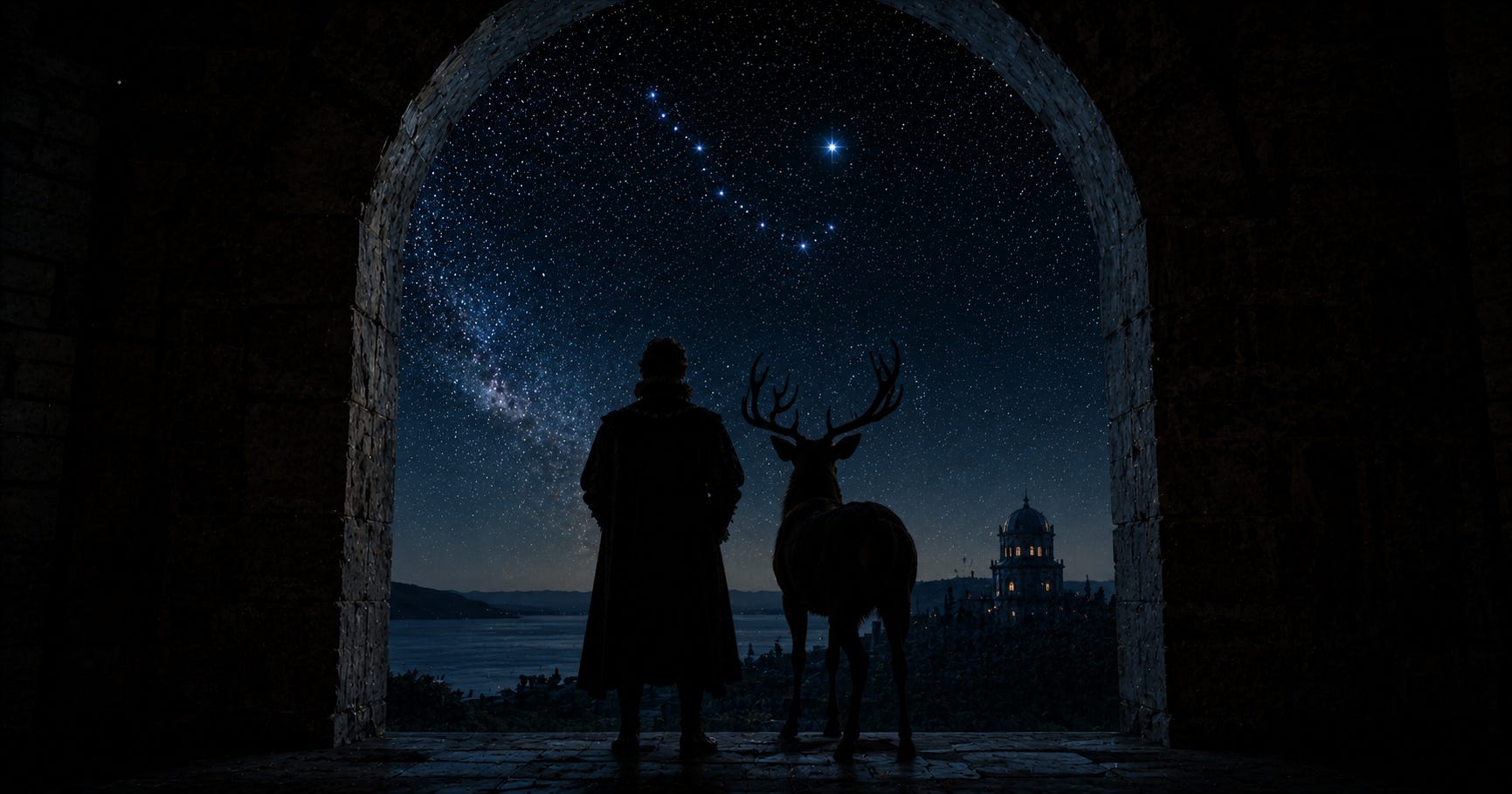
He kept a pet elk. The elk lived inside the castle like a large, antlered dog, trotting alongside Brahe’s carriage on outings and joining its owner at parties, where it developed — with Brahe’s enthusiastic encouragement — a taste for Danish beer. The elk’s life ended when it drank too much at a party at a nearby castle, climbed a staircase, and fell back down, fatally injuring itself. Brahe reported the incident in a letter with what seems to have been genuine grief.
He employed a court jester named Jepp — a little person whom Brahe believed, with complete sincerity, to possess psychic and clairvoyant abilities. Jepp sat under the table during meals. The reasoning for this arrangement has never been satisfactorily explained.
When the King of Denmark died and his successor withdrew Brahe’s funding, the astronomer packed up his instruments and his data and relocated to Prague, where the Holy Roman Emperor Rudolf II became his new patron. He died in 1601 — according to some accounts, of a bladder complication suffered because he felt it would be impolite to leave a royal banquet to use the restroom. Whether this is precisely true or a story that simply feels true about Tycho Brahe is, at this point, impossible to determine.
The Record Shows
Tycho Brahe spent his life collecting data he didn’t fully know how to interpret. His cosmological model — a compromise between the Earth-centered and Sun-centered universes — turned out to be wrong. But the data he collected was right. It was precise enough that someone else — someone with better mathematics and more patience — could take it and change everything. Brahe was the person who made Kepler possible. Kepler was the person who made Newton possible. Newton made almost everything else possible. Somewhere in that chain of giants, there is a man with a copper nose, grieving an elk, and pointing instruments at the sky from a castle on a Danish island. History doesn’t always give the credit to the right person. Brahe at least has the distinction of having made it possible for someone else to be right.
Sources
· Britannica — Tycho Brahe (britannica.com/biography/Tycho-Brahe-Danish-astronomer)
· FlipScience — Of Castles, Pet Elks, and Fake Noses: Tycho Brahe’s Incredible Life (flipscience.ph)
· Gizmodo — The Crazy Life and Crazier Death of Tycho Brahe (gizmodo.com)
· Mental Floss — Tycho Brahe: The Astronomer With a Drunken Moose (mentalfloss.com)
If someone forwarded this to you and you’d like to receive Lost in the Record weekly, subscribe free at lostintherecord.substack.com