


The Man
Sequoyah was born around 1770 in the Cherokee town of Tuskagee, in what is now eastern Tennessee. His mother, Wuh-teh, was a member of the Red Paint Clan and raised him alone — his father, believed to be a white trader or soldier, was largely absent from his life. As a boy, Sequoyah walked with a limp, likely from an injury or illness in childhood. He grew up speaking only Cherokee. He never learned to read or write in English, or in any other language. He never attended school.
He became a silversmith, a trader, and an artist — skilled with his hands in the way that people who grow up solving practical problems tend to be. He fought alongside Andrew Jackson, Sam Houston, and David Crockett in the War of 1812 against the Creek Nation. It was there, watching American soldiers write letters home and pass written orders between generals, that something clicked.
The Cherokee had no written language. Everything — history, law, ceremony, knowledge — lived in memory and in spoken word alone. One generation died and took irreplaceable things with it. Sequoyah watched the Americans write things down and understood, with sudden clarity, what his people were missing. He called written language “talking leaves.” And he decided, alone, with no training and no model to follow, to give his people one.
The Twelve Years
He began around 1809. His first approach was to draw a symbol for every word in the Cherokee language. He worked for months before realizing the task was impossible — there were simply too many words, and the system would be too complex for anyone to learn. He started over.
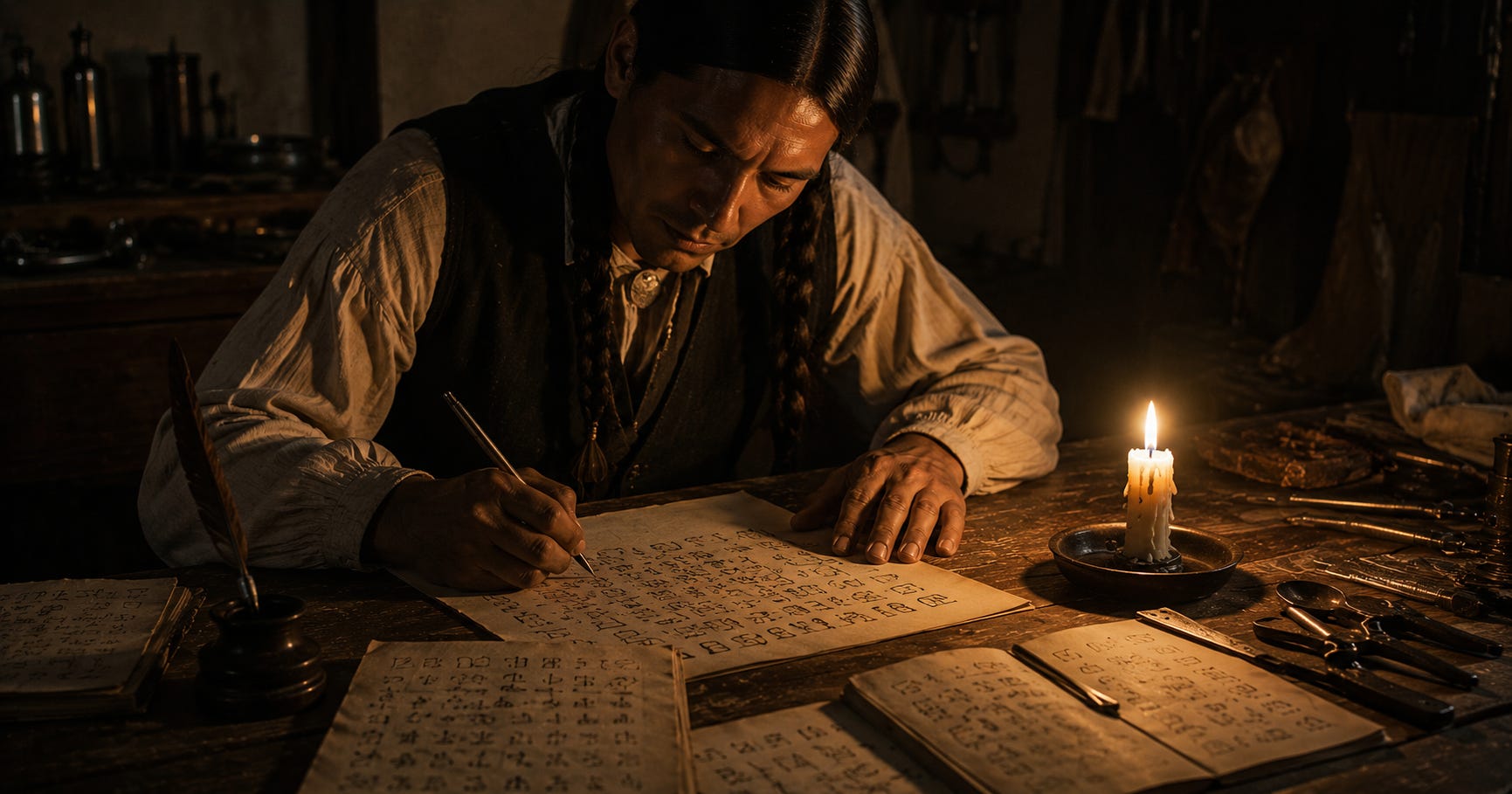
This time he listened differently. He sat with the spoken language and pulled it apart — not into words but into sounds, into syllables. He heard patterns. He isolated them. He eventually identified 86 distinct syllables that formed the foundation of spoken Cherokee. Then he designed a symbol for each one. Some symbols he adapted from letters he had seen in an English Bible, a Greek text, and other printed materials — not because he could read them, but because he liked the shapes. He gave them entirely new meanings.
His family thought he had lost his mind. His wife burned his early work at least once, convinced it was witchcraft. Neighbors mocked him. The work consumed twelve years of his life. He kept going.
He had no blueprint. No teacher. No funding. No institutional support. Just a lame silversmith in a workshop, listening to his own language with the focused intensity of a man who had decided something impossible was merely difficult.
The Demonstration
By 1821, Sequoyah was ready. He called together Cherokee leaders, neighbors, and community elders to present what he had created. They were skeptical — politely at first, then less so. Some accused him outright of practicing witchcraft. He had anticipated this.
He sent his young daughter, Ahyoka — who had been learning the syllabary alongside him — out of the room. He asked the assembled men to say any word they chose. He wrote it down using his symbols. Then he called Ahyoka back in and asked her to read what he had written.
She read it aloud, perfectly.
The room went quiet. Then the questions started — careful, cautious, wondering questions from men who were beginning to understand what they were looking at. Sequoyah demonstrated again. And again. By the end of the gathering, the skeptics were asking to be taught.
Within months, the syllabary had spread through the Cherokee Nation. Within a year, thousands of Cherokee people could read and write in their own language — a literacy rate that surpassed many surrounding white communities. In 1828, the Cherokee Phoenix became the first Native American newspaper in the United States, printed in both English and Cherokee using Sequoyah’s syllabary. The system was so elegantly designed that most people could learn it in just a few days.
What It Meant
Sequoyah spent the rest of his life traveling and teaching. He moved west with a group of Cherokee to present-day Arkansas, then later to Oklahoma. He worked to unite the Eastern and Western Cherokee — separated by forced relocation — through written correspondence made possible by his invention. He died around 1843 in Mexico, searching for a rumored group of Cherokee who had fled there decades earlier rather than submit to American authority. He was still looking for ways to connect his people when he died.
His name was given to the giant sequoia trees of California — among the largest and oldest living things on earth — as a tribute to his stature. A statue of Sequoyah stands in the United States Capitol, one of only two statues representing the state of Oklahoma. He is the only person in history known to have single-handedly created an entire writing system that was then adopted by a people and used as their primary written language.
He could not read when he started. He could not write. He had no formal education, no institutional backing, and no community support — only a conviction, held quietly for twelve years, that his people deserved to have their words written down.
The Record Shows
What Sequoyah did has no real parallel in human history. Writing systems are typically the product of civilizations — whole societies, over centuries. Sequoyah did it alone, in twelve years, while his wife burned his notes and his neighbors called him a fool. The detail that stops me every time is this: he couldn’t read when he began. He built the door before he had the key. And when he finally finished, he handed both to everyone he knew and kept walking — looking for more people to give them to.
Sources
· Britannica — Sequoyah (britannica.com/biography/Sequoyah)
· National Geographic Education — Sequoyah and the Creation of the Cherokee Syllabary (education.nationalgeographic.org)
· PBS American Masters — How Sequoyah Created a Written Language for the Cherokee Nation (pbs.org)
· History.com — How a Cherokee Leader Ensured His People’s Language Survived (history.com)
· Tennessee State Museum — Sequoyah and His Syllabary (tnmuseum.org)
If someone forwarded this to you and you’d like to receive Lost in the Record weekly, subscribe free at lostintherecord.substack.com
I LOVE this! What an incredible testament to perseverance & commitment. He saw that his people needed to preserve their history & the best way was through written language. He saw the need for his people to have their own written language & he fulfilled it. He stayed the course, against all odds, until it was complete and then went out into the land to teach it to others until his death. Wow!!