


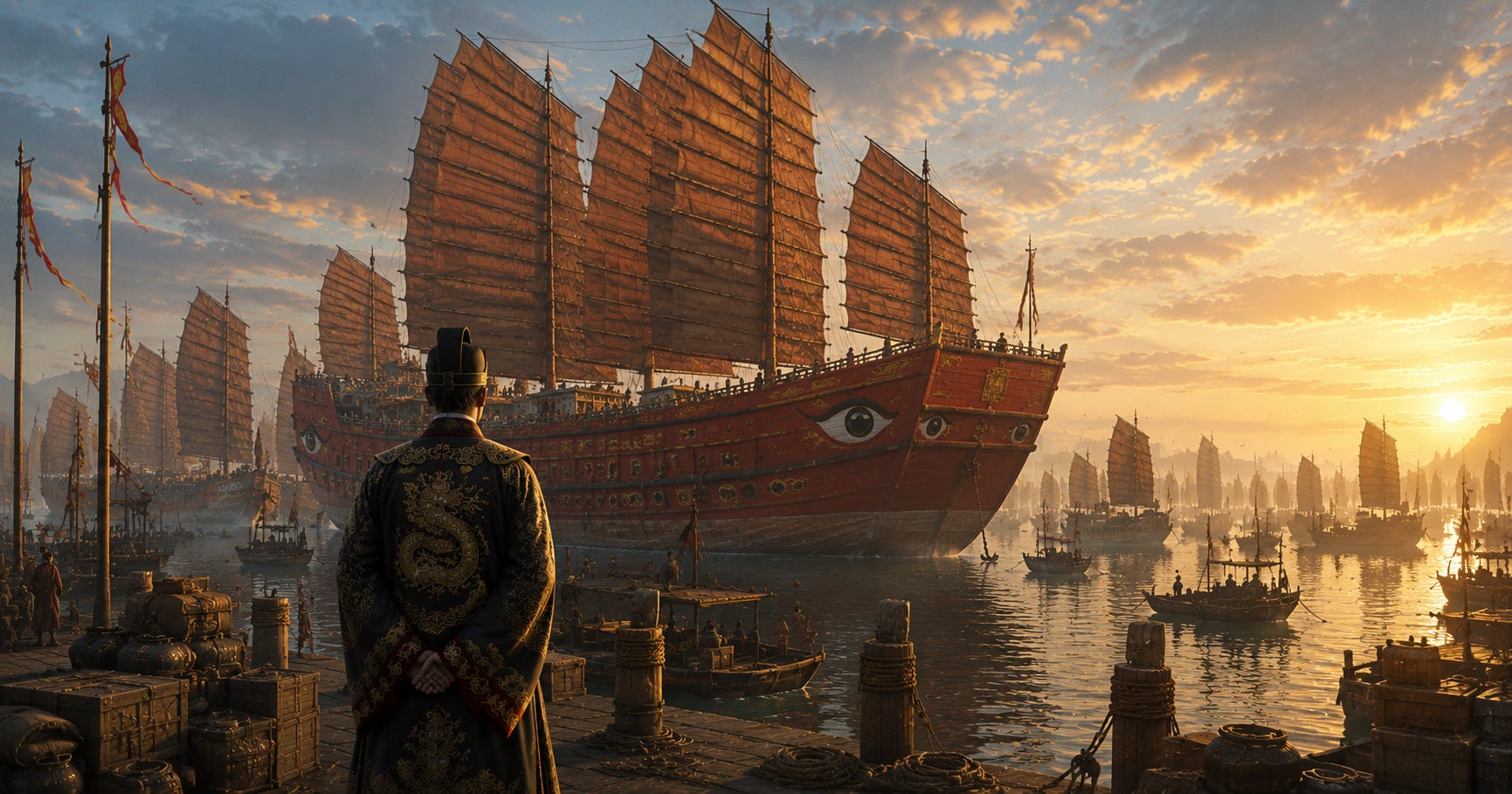
The Beginning
In 1381, forces of China’s Ming dynasty invaded Yunnan, one of the last major strongholds of Yuan loyalists in southern China.
Among those captured was a young Muslim boy named Ma He.
He was probably around ten years old.
He was castrated and eventually sent into the household of Zhu Di, a Ming prince and the son of the dynasty’s founder.
It was a beginning that offered almost no hint of what his life would become.
Over the next two decades, Ma He distinguished himself in Zhu Di’s service.
Historical accounts describe him as unusually tall and physically imposing, reportedly standing nearly seven feet, although such descriptions cannot be independently verified. What is much clearer is that he earned Zhu Di’s trust through military service and proved himself capable in command, organization, and diplomacy.
That relationship would change both of their lives.
In 1399, Zhu Di launched a civil war against his nephew, the Jianwen Emperor.
Ma He fought on Zhu Di’s side.
Three years later, Zhu Di captured the capital and took the throne.
He became the Yongle Emperor.
Ma He had helped him get there.
The emperor rewarded his trusted officer with a new surname.
Ma He became Zheng He.
Then Yongle gave him an assignment that would make his name famous centuries later.
He would command an enormous imperial fleet into the seas beyond China.
The Fleet
On July 11, 1405, the Yongle Emperor issued the order for what would become Zheng He’s first great maritime expedition.
The scale was extraordinary.
Historical sources differ on the exact numbers, but the first expedition may have involved more than 200 vessels and nearly 28,000 men.
There were soldiers, sailors, translators, physicians, officials, craftsmen, merchants, and diplomats.
At the center of the fleet were the famous treasure ships.
Their actual size remains one of the most debated questions surrounding Zheng He’s voyages.
Traditional Ming accounts describe vessels reaching roughly 400 feet in length. Modern scholars have questioned whether wooden ships of that size could have operated successfully at sea and have proposed smaller estimates.
Whatever their exact dimensions, they were among the largest and most ambitious ships of their age.
And there were many of them.
Over the next twenty-eight years, Zheng He would lead or oversee seven major expeditions.
His fleets traveled through Southeast Asia, across the Indian Ocean, to the Arabian Peninsula, and along the eastern coast of Africa.
They reached ports in present-day Indonesia, India, Sri Lanka, Oman, Yemen, Somalia, and Kenya.
This was not exploration in the later European sense of sailing into completely unknown waters.
The Indian Ocean had supported sophisticated trading networks for centuries.
Arab, Persian, Indian, African, and Southeast Asian merchants already crossed these routes.
What Zheng He’s fleet represented was something different.
It was an extraordinary projection of imperial power.
The Ming court sent gifts and demanded recognition of the emperor’s authority. Foreign rulers dispatched tribute missions to China. Trade expanded alongside diplomacy.
And when diplomacy failed, Zheng He’s fleet could use force.
In 1407, his forces defeated the pirate leader Chen Zuyi near Palembang, in present-day Indonesia. Chen had threatened shipping around the strategically important Strait of Malacca.
Later, during a confrontation in Sri Lanka, Zheng He’s forces defeated those of the ruler Alagakkonara. The king was captured and transported to China to appear before the Ming court.
The voyages also brought extraordinary animals back to the imperial capital.
Among the most famous was a giraffe presented through an East African trading connection.
At the Ming court, the animal was associated with the qilin, a mythical creature whose appearance was traditionally considered a sign of virtuous rule.
For the Yongle Emperor, it was perfect political symbolism.
His empire was not merely powerful.
The world appeared to be coming to China.
By the early fifteenth century, Zheng He’s expeditions had demonstrated a capacity to project Chinese naval power thousands of miles from home on a scale few governments of the period could match.
Then the political winds changed.
The End of the Voyages
The Yongle Emperor died in 1424.
His son, the Hongxi Emperor, immediately suspended the treasure voyages.
The expeditions were enormously expensive, and the Ming government faced competing priorities closer to home.
China’s northern frontier remained vulnerable to Mongol military pressure. Maintaining defenses, armies, government projects, and the imperial capital consumed enormous resources.
There were also powerful officials who questioned the value of the voyages.
Some Confucian scholars regarded the enormous expenditures as wasteful. Traditional Confucian political thought generally placed agriculture above commerce, and powerful court factions disagreed over how much attention the empire should devote to distant maritime ventures.
But the suspension did not last forever.
The Hongxi Emperor died after less than a year on the throne.
His successor, the Xuande Emperor, eventually authorized one more expedition.
In 1430, Zheng He received orders for what would become his seventh and final voyage.
By then he was an aging man who had spent much of his adult life moving between imperial courts, foreign ports, and the decks of enormous ships.
The fleet departed again.
It would be Zheng He’s last journey.
He died in 1433, probably during the return voyage from India.
Tradition places his death at or near Calicut, although the precise circumstances remain uncertain.
He was approximately sixty-two years old.
His fleet returned to China without him.
And there would never be another expedition like it.
What Happened Next
The disappearance of Zheng He’s great fleets is sometimes portrayed as a dramatic act of deliberate historical destruction.
The reality is more complicated.
China did not suddenly forget how to build ships.
Chinese merchants continued sailing.
Coastal trade continued.
Maritime communities remained active throughout East and Southeast Asia.
What ended was something much more specific: the enormous, government-sponsored treasure fleets built to carry imperial power across the Indian Ocean.
The priorities of the Ming state had changed.
The ships eventually disappeared.
The massive expeditions stopped.
Much of the documentation associated with them was lost.
And over time, Zheng He’s voyages became far less prominent in Chinese historical memory than their astonishing scale might suggest.
There is a famous story that helps explain why.
During the late fifteenth century, Ming officials reportedly searched for records of Zheng He’s expeditions because another emperor was considering renewed maritime missions.
According to later accounts, the official Liu Daxia had hidden or destroyed the documents because he believed the voyages had been extravagant and harmful.
For generations, that story was repeated as evidence that officials deliberately erased Zheng He’s achievement.
Modern historians, however, have questioned whether the incident happened in exactly that way.
Some research suggests that the destroyed documents may have involved military campaigns elsewhere rather than Zheng He’s voyages.
What can be said with confidence is that many records did disappear.
But Zheng He himself was never completely erased.
Accounts survived.
Official histories mentioned the voyages.
Participants left written descriptions.
Stone inscriptions recorded portions of the expeditions.
Communities throughout Southeast Asia preserved memories and traditions associated with Zheng He long after the treasure fleets vanished.
The story survived.
Just imperfectly.
A Different Age of Exploration
Sixty-five years after Zheng He’s final voyage ended, another fleet arrived at Calicut.
In May 1498, the Portuguese navigator Vasco da Gama reached India after sailing around the southern tip of Africa.
The expedition marked the beginning of a new phase in Indian Ocean history.
Unlike Zheng He’s missions, Portuguese voyages were part of an expanding system focused heavily on controlling trade routes, establishing fortified ports, and using naval force to influence commerce.
Within decades, Portuguese fleets had established powerful positions around the Indian Ocean.
They never completely controlled its trade.
The ocean was too vast, and its commercial networks were too deeply established.
But the balance of maritime power was changing.
European ships would increasingly appear along routes that Chinese imperial fleets had crossed generations earlier.
It is tempting to see this as a simple moment when China withdrew and Europe stepped into the space it abandoned.
History was not that neat.
European expansion had its own technological, economic, political, and religious causes.
China’s decision to end the treasure voyages did not create an empty ocean waiting to be claimed.
But the contrast is still striking.
At the beginning of the fifteenth century, one of the most powerful naval forces on Earth sailed under the Ming flag.
By the beginning of the sixteenth, those expeditions had become a memory.
Remembering Zheng He
Zheng He was never entirely forgotten.
But his place in Chinese historical memory changed dramatically over time.
In 1904, Chinese intellectual Liang Qichao published an influential biography of Zheng He.
China at the time was confronting enormous pressure from European imperial powers and Japan.
For Liang, Zheng He’s voyages represented evidence of a very different Chinese past.
Here was a Chinese admiral who had sailed across the Indian Ocean generations before the great European maritime empires emerged.
His story became newly relevant.
Zheng He gradually returned to greater prominence in Chinese history and popular culture.
A century later, in 2005, China established July 11 as Maritime Day, commemorating the date traditionally associated with the beginning of Zheng He’s first expedition.
Six hundred years after the Yongle Emperor ordered the fleet to sail, Zheng He’s name had once again become inseparable from China’s maritime past.
The Record Shows
Zheng He’s life is extraordinary even without the legends that accumulated around it.
A Muslim boy captured during a war in Yunnan was castrated and placed into imperial service.
He rose through the household of a prince.
He fought in a civil war.
He became one of the new emperor’s most trusted servants.
Then he was given command of one of the largest naval enterprises the world had yet seen.
For nearly three decades, his fleets crossed thousands of miles of ocean, carrying diplomats, soldiers, merchants, gifts, animals, and messages from one of the most powerful emperors on Earth.
Then the voyages stopped.
Not because China suddenly lost the ability to sail.
Not because every record was deliberately burned.
And not because the Indian Ocean became empty.
They stopped because governments change.
Rulers die.
Priorities shift.
Expensive projects lose political support.
And sometimes achievements that once seemed central to an empire’s identity become peripheral to the generations that follow.
That may be the most remarkable part of Zheng He’s story.
Something does not have to be completely erased to become lost in the record.
Sometimes history disappears more quietly.
The ships stop sailing.
The people who remember them die.
The documents become scattered.
And an achievement that once stretched across an ocean gradually becomes a story that later generations have to rediscover.
Sources
Britannica, Zheng He
National Geographic, The Seven Voyages of Zheng He
World History Encyclopedia, The Seven Voyages of Zheng He
JSTOR Daily, Zheng He, the Great Eunuch Admiral
Edward L. Dreyer, Zheng He: China and the Oceans in the Early Ming Dynasty, 1405–1433
Louise Levathes, When China Ruled the Seas
Liang Qichao, Biography of Our Homeland’s Great Navigator, Zheng He
If someone forwarded this to you and you’d like to receive Lost in the Record weekly, subscribe free at lostintherecord.substack.com
I remember watching a TV documentary that suggested that Zheng He's expeditions may have even made it to the West coast of the Americas. Whether he made it there or not, he deserves to be remembered as a great explorer.