


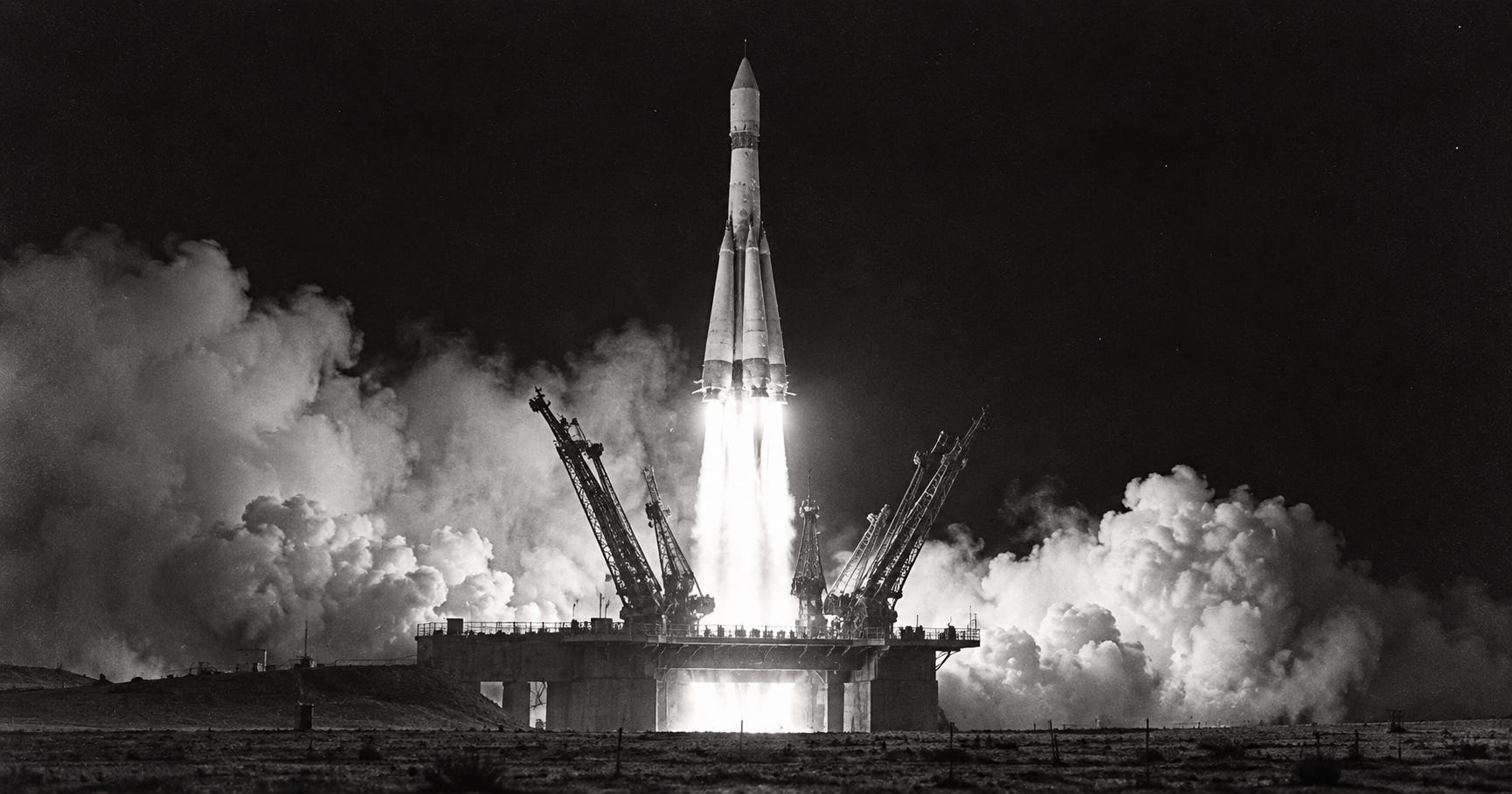
The Boy at the Air Show
Sergei Pavlovich Korolev was born on January 12, 1907, in Zhytomyr, a city in what is now Ukraine. At six, he went to an air show and couldn’t stop thinking about it. Flying machines were new, loud, and nearly magical, and the boy decided he wanted to build them.
The Russian Revolution threw his schooling into chaos, so his stepfather, an electrical engineer named Grigory Balanin, tutored him at home. The boy turned out to have a gift for mathematics. He never really stopped chasing flight. At 17, he designed a glider. He studied aviation in Kyiv, then moved to Moscow in 1926 to study under Andrei Tupolev, one of the most celebrated aircraft designers in the Soviet Union. In 1932, Korolev took charge of a small Moscow club of rocket enthusiasts known by its Russian initials, GIRD: the “Group for the Study of Reactive Motion.” Its members joked that the letters really stood for “Group of Engineers Working for Nothing.”
On November 25, 1933, the group launched the GIRD-X, the first Soviet rocket powered by liquid fuel. It climbed about 80 meters. It was a modest flight, but it worked. Korolev was 26 years old, and he was on his way.
Then, in a single night, it all stopped.
The Arrest
On June 27, 1938, Soviet secret police arrested Korolev. Stalin’s purges were sweeping through the country, and they swept through the rocket institute where he worked. Colleagues under pressure named one another. Korolev was convicted on false charges and sentenced to ten years.
In 1939, he was shipped to Kolyma, a network of labor camps in the far east of Siberia. He spent months working in a gold mine. Scurvy took most of his teeth. In December 1939, half-starved, he was put on a train back to Moscow for a new investigation.
In 1940, he was sentenced again, this time to eight years, and sent to a special prison for scientists and engineers, the kind the Soviet system used to keep useful minds working while keeping them locked up. His old teacher, Tupolev, was a prisoner there too. Korolev was officially released from confinement in July 1944.
Released is not the same as cleared. His original conviction still stood. For years afterward, the engineer the Soviet state would come to depend on most was, on paper, still a convicted criminal.
He was not formally cleared until 1957, the same year his rocket would put the first satellite into orbit.
The Satellite
After World War II, the Soviet Union wanted long-range missiles, and Korolev was the man they needed to build them. He became chief designer of a rocket called the R-7, built to carry a nuclear warhead across the world.
Korolev wanted it to carry something else.
On May 26, 1954, just six days after he was put in charge of the R-7 program, Korolev sent the government a proposal to use the rocket to launch an artificial satellite. He wasn’t alone in the idea. His longtime colleague Mikhail Tikhonravov had been studying satellites for years, and Korolev championed his work. Historians are clear that Sputnik was a team achievement, and that Tikhonravov deserves far more credit than he has received. But it was Korolev who had the rocket, the authority, and the stubbornness to push the idea through a government that cared mostly about missiles. In January 1956, the government approved a large, complex scientific satellite.
It fell behind schedule. And Korolev was watching the Americans. In July 1955, the United States had announced its own plans to put a satellite in orbit. Korolev didn’t intend to come second.
So he changed the plan. Instead of a 1,400-kilogram observatory, he proposed something simple: a polished metal sphere that would do almost nothing except prove it was there. Its official name was PS-1. The letters stood for Prosteishiy Sputnik, the “simplest satellite.”
It weighed 83.6 kilograms, about 184 pounds. It measured 58 centimeters across, roughly the size of a beach ball. Four long antennas swept back from it like whiskers. Inside were batteries and a radio transmitter that would do one thing: beep.
The launch had been planned for October 6, 1957. Korolev moved it up two days, worried the Americans might get there first.
On October 4, at 10:28 p.m. Moscow time, the R-7 lifted off from a launch site in the steppe of Kazakhstan. Minutes later, the sphere separated and fell into orbit. Korolev was cautious even then, telling his team to hold off celebrating until the tracking stations confirmed the signal.
They confirmed it. Sputnik was circling the Earth every 96 minutes, beeping on two radio frequencies anyone with the right receiver could hear. Amateur radio operators around the world tuned in. For 22 days, until its batteries died on October 26, the little sphere kept talking. It stayed in orbit for three months, circling the planet 1,440 times, before it fell back into the atmosphere and burned up on January 4, 1958.
Even the people who built it didn’t grasp it at first. Nikita Khrushchev later recalled that when he got the news, he congratulated the engineers “and calmly went to bed.” Boris Chertok, Korolev’s deputy, said it took the team “four or five days to realize that from then on, the history of civilization could be divided into before the launch and after.”
The whole world heard his satellite. Almost no one in the world knew his name.
The Chief Designer
Sputnik terrified and thrilled the planet. Newspapers everywhere ran the story. The United States, stunned, poured money into science, education, and its own space program, and within a year it had created NASA. The space race had begun, and a single beeping ball of metal had started it.
And the man most responsible for it was invisible.
Read the Soviet government’s own announcement closely and you can see the pattern starting. The official news agency, TASS, credited the satellite to “great, intense work of scientific institutes and design bureaus.” There were no names. It wasn’t an oversight. The people who built the rocket were state secrets, and they would stay that way.
The Soviet government refused to name him. In public, Korolev was referred to only as the Glavny Konstruktor, the “Chief Designer.” The official explanation was that his identity had to be protected from assassination by the West. When he wrote articles about space for Soviet newspapers, he published them under a false name: “Professor K. Sergeyev.” Even some of the cosmonauts who worked with him didn’t know his real name.
The secrecy held as his achievements piled up. A month after Sputnik, a second satellite carried a dog named Laika into orbit. Then came probes to the Moon.
On April 12, 1961, Korolev’s team put Yuri Gagarin into orbit aboard Vostok 1, making him the first human being in space. Korolev was at the launch site, speaking with Gagarin over the radio as he sat in the capsule. Gagarin became one of the most famous people on Earth, celebrated in parades and greeted by crowds across the world.
The man who sent him up stood out of frame. He gave no interviews under his own name. He could not tell the world what he had built.
The Name Revealed
In January 1966, Korolev went into a Moscow hospital for what was supposed to be routine surgery. He died on January 14, at the age of 59. Accounts of exactly what went wrong during the operation still differ.
Two days later, on January 16, Pravda ran his obituary, with a photograph of Korolev wearing his medals. For most of the world, that was the first time they learned his name.
He was given a state funeral. His ashes were placed in the Kremlin Wall, one of the highest honors the Soviet Union could give.
Less than three weeks after his death, on February 3, 1966, a Soviet probe called Luna 9 made the first soft landing on the Moon. Its design had begun in Korolev’s own bureau. His program kept going without him. It had been built that way, by a man who had learned the hard way that a system can go on without any one person in it.
The Record Shows
Sergei Korolev spent six years as a prisoner of the country he would later carry into space. He came out with damaged health and most of his teeth gone, and he went straight back to work for the government that had put him there. Then he gave it the greatest technical triumph in its history, and the price of the work was that he would never be named for it. I find it hard to imagine many people agreeing to that bargain, and harder to imagine anyone keeping it as quietly as he did. History tends to remember the person in the photograph: the cosmonaut on the parade float, the leader at the podium. Behind most of those photographs stands someone who drew the plans and was never thanked by name. The record should show who built the rocket.
Sources
· Wikipedia, “Sergei Korolev” (https://en.wikipedia.org/wiki/Sergei_Korolev)
· Wikipedia, “Sputnik 1” (https://en.wikipedia.org/wiki/Sputnik_1)
· Siddiqi, Asif A. “Korolev, Sputnik, and the International Geophysical Year.” NASA History Office (https://www.nasa.gov/history/sputnik/siddiqi.html)
· NPR, “Sputnik’s Designers Didn’t Fathom Its Impact,” October 4, 2007 (https://www.npr.org/2007/10/04/14949640)
· Siddiqi, Asif A. Challenge to Apollo: The Soviet Union and the Space Race, 1945–1974. NASA SP-2000-4408, 2000 (https://www.nasa.gov/wp-content/uploads/static/history/SP-4408pt1.pdf)
· Linda Hall Library, “Scientist of the Day: Sergei Korolev” (https://www.lindahall.org/about/news/scientist-of-the-day/sergei-korolev/)
· Institution of Engineering and Technology, “Putting the Red Star in Orbit” (https://engx.theiet.org/b/blogs/posts/putting-the-red-star-in-orbit)
· Wikipedia, “Group for the Study of Reactive Motion” (https://en.wikipedia.org/wiki/Group_for_the_Study_of_Reactive_Motion)
· Wikipedia, “Luna 9” (https://en.wikipedia.org/wiki/Luna_9)
· Wikipedia, “NASA” (https://en.wikipedia.org/wiki/NASA)
· The Engineer, “Late Great Engineers: Sergei Korolev, Designated Designer” (https://www.theengineer.co.uk/content/in-depth/late-great-engineers-sergei-korolev-designated-designer)
· Smithsonian Air & Space, “The Man Behind the Curtain” (https://www.smithsonianmag.com/air-space-magazine/the-man-behind-the-curtain-22131111)
Just surprised that he even survived through those conditions during imprisonment. He overcame so much.
Korolev had heart problems, which were believed to be the result of the inhumane conditions of his confinement. Another parallel of an identity kept secret is Igor Kurchatov, the father of the Soviet A-bomb.