


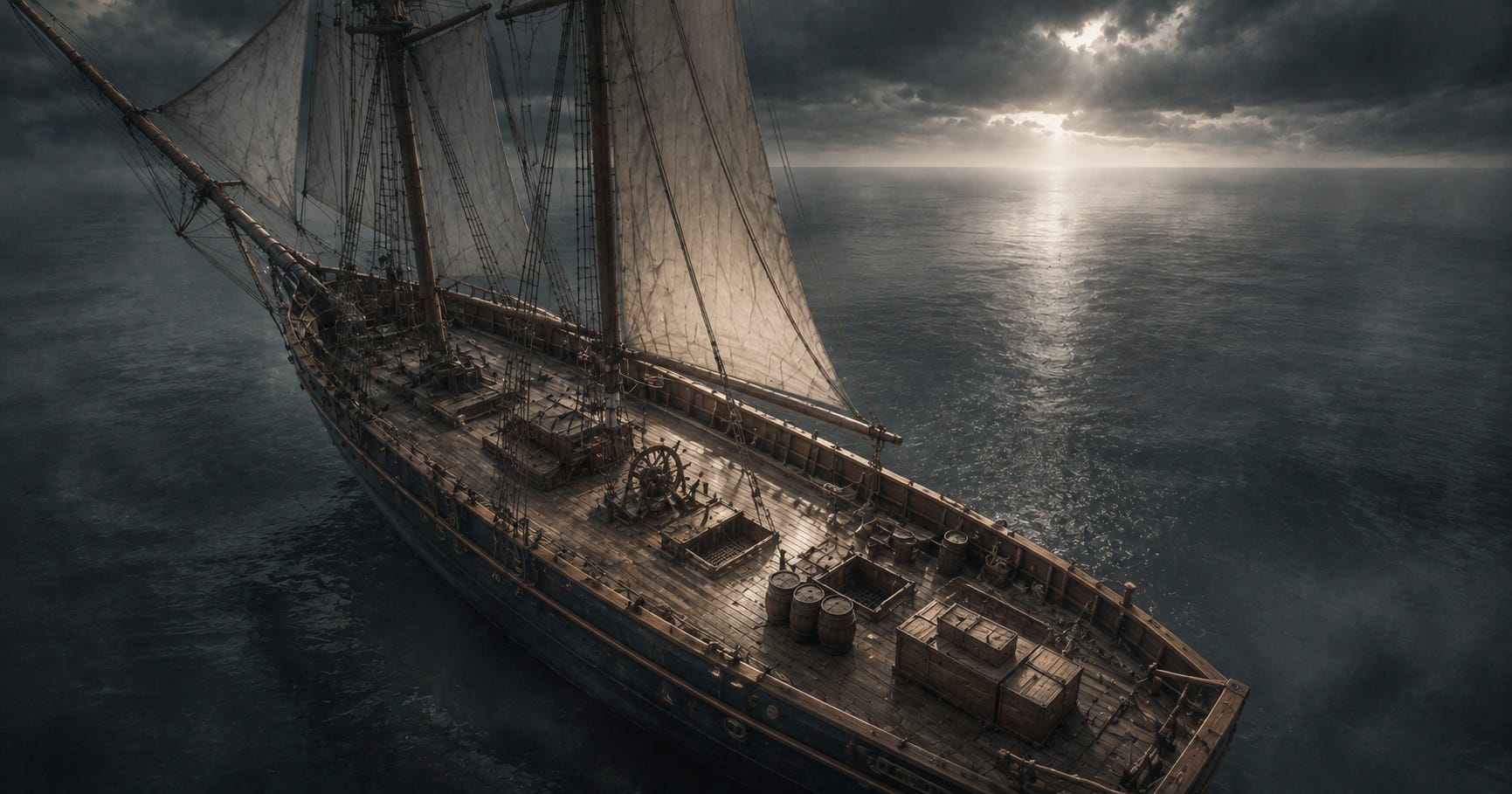
The Voyage
On November 7, 1872, the American merchant brigantine Mary Celeste left New York Harbor bound for Genoa, Italy. She was carrying 1,701 barrels of industrial alcohol, a crew of seven experienced sailors, and three passengers: Captain Benjamin Spooner Briggs, his wife Sarah, and their two-year-old daughter Sophia.
Captain Briggs was forty-four years old, respected in his profession, and not given to drama. He had handpicked his crew carefully. He did not drink. He was the kind of captain other captains wanted to be — steady, experienced, and trustworthy. His wife and daughter had made sea voyages with him before. This was an ordinary commercial crossing.
The Mary Celeste encountered rough weather for the first two weeks of the voyage, battling through the Atlantic toward the Azores. The last entry in the ship’s log was dated November 25, 1872. The position recorded placed the ship approximately six miles from the Azores. Everything was normal.
Then — nothing. No distress signal. No message in a bottle. No debris trail. No washed-up lifeboat. Nothing.
The Discovery
On December 4, 1872 — ten days after the last log entry — the Canadian brigantine Dei Gratia was sailing approximately four hundred miles east of the Azores when her crew spotted a vessel moving erratically. As the Dei Gratia drew closer, the crew recognized the Mary Celeste. Captain David Morehouse knew Briggs personally. He had dined with him just days before the Mary Celeste departed New York.
Morehouse sent a boarding party across. What they found has puzzled historians, maritime experts, and curious readers for over a hundred and fifty years.
The ship was seaworthy. Its cargo of 1,701 barrels of alcohol was largely intact — nine barrels were inexplicably empty, but the rest were undisturbed. The crew’s personal belongings were in their quarters, untouched. There was a six-month supply of food and fresh water on board. In one cabin, a sewing machine sat mid-project. Children’s toys were scattered on the floor.
The ship’s only lifeboat was missing. The navigational instruments were gone. The last log entry was dated ten days earlier — and described perfectly normal conditions. And not a single one of the ten people who had sailed aboard the Mary Celeste was ever seen again.
There were no signs of struggle. No blood. No damage consistent with a storm or collision. No evidence of piracy — nothing had been looted, and pirates generally loot. The rigging was slightly damaged but the ship was fully capable of sailing. It appeared, in the words of one investigator, that the crew had simply stepped off the ship — quickly, but not in panic — and vanished into the Atlantic.
The Theories
The British admiralty court in Gibraltar conducted a full investigation and found no evidence of foul play. Which left an uncomfortable question: if not foul play, then what?
The theories have multiplied for a century and a half. Piracy — ruled out by the untouched cargo. Mutiny — ruled out by the captain’s reputation and the crew’s known loyalty. A rogue wave — possible, but the ship showed no damage consistent with one. A waterspout — similarly undisupported by evidence. Alcohol fumes from the cargo igniting or threatening to ignite — currently the most widely accepted explanation, suggesting the crew evacuated temporarily in the lifeboat, tethered to the ship, and the rope snapped in rough seas, leaving them adrift and the ship sailing on without them.
But this too is a theory. No one knows. The Mary Celeste sailed on under new captains, considered cursed, for another thirteen years before being deliberately wrecked off Haiti in 1885 — for insurance money, which feels like an appropriately dark final chapter. The wreck was located in 2001 but by then the sea had taken most of it.
Arthur Conan Doyle, creator of Sherlock Holmes, wrote a fictional account of the mystery in 1884. It made the story famous and muddled the facts so thoroughly that newspapers began spelling the ship’s name wrong — Marie Celeste instead of Mary Celeste — and the error persisted for decades. Even the ghost ship’s name got lost in the record.
Benjamin Briggs, Sarah Briggs, two-year-old Sophia, and their seven crewmates were never found. No bodies. No messages. No explanation. Just a perfectly good ship sailing itself across the Atlantic with nobody at the wheel, and ten empty chairs at the table below.
The Record Shows
The Mary Celeste endures because it is the purest kind of mystery — one with no resolution and no villain to blame. We can accept tragedies. We can accept disasters. What we struggle to accept is simply not knowing. The ten people aboard that ship left behind a sewing machine mid-stitch and a child’s toys on the floor. They had food for six months and water for six months. They had no apparent reason to leave. And they left. Whatever happened in those ten days between the last log entry and the Dei Gratia’s discovery, it happened beyond the reach of history. Some records stay lost no matter how long we look.
Sources
· Wikipedia — Mary Celeste (en.wikipedia.org/wiki/Mary_Celeste)
· Smithsonian Magazine — Abandoned Ship: The Mary Celeste (smithsonianmag.com)
· Britannica — Mary Celeste (britannica.com/topic/Mary-Celeste)
· History.com — The Mystery of the Mary Celeste (history.com)
· Hicks, Brian. Ghost Ship: The Mysterious True Story of the Mary Celeste and Her Missing Crew. Ballantine Books, 2005.
If someone forwarded this to you and you’d like to receive Lost in the Record weekly, subscribe free at lostintherecord.substack.com
Maybe there was a spreading disease they were afraid on from some of the food contents etc. interesting story!
I'm partial to the alcohol theory in that the few empty barrels somehow caught fire. Knowing that the ship's hold was full of it, evacuating made sense but, as you point out, the rope to the lifeboat snapped and the survivors drifted away into oblivion.