


The Man
Maurice Ward was not a scientist. He was not an engineer, a chemist, or a materials researcher. He was a hairdresser from Hartlepool, a small town on the northeast coast of England, who liked to tinker with things in his spare time.
Born in 1933, Ward spent his professional life cutting hair and took quiet pride in his craft. “What L’Oreal and Garnier are doing today,” he once said, “I was doing fifty years ago. And they still haven’t got it right.” He was a man who believed in his own instincts — sometimes to a fault, as the world would eventually discover.
In the early 1980s, Ward bought a second-hand industrial extruder from a local chemical plant and began experimenting in his home workshop. He was trying to develop a material that could be used in car bonnets. His early attempts failed. He granulated the samples and forgot about them.
Then, in 1985, a British Airtours flight caught fire on the runway at Manchester Airport. Fifty-five people died — not from the fire itself but from toxic smoke inhalation, in under forty seconds. Ward watched the news coverage and felt something shift in him. He went back to his workshop.
The Invention
What emerged from that workshop over the next few years was something that should not have been possible for a self-taught hairdresser working with household materials and a second-hand machine.
Ward called it Starlite — a name coined by his granddaughter Kimberly. It was a plastic-like material, smooth and paintable, made from a combination of what Ward described as twenty-one polymers and copolymers with added ceramics. He claimed it could be applied to surfaces like paint. He claimed it could withstand temperatures beyond 3,000 degrees Celsius. He claimed it produced no toxic fumes when exposed to heat.
These claims sounded, to almost everyone who heard them, like the enthusiastic fantasies of an amateur. Then Ward appeared on the BBC’s science program Tomorrow’s World in 1990 and demonstrated what Starlite could do.
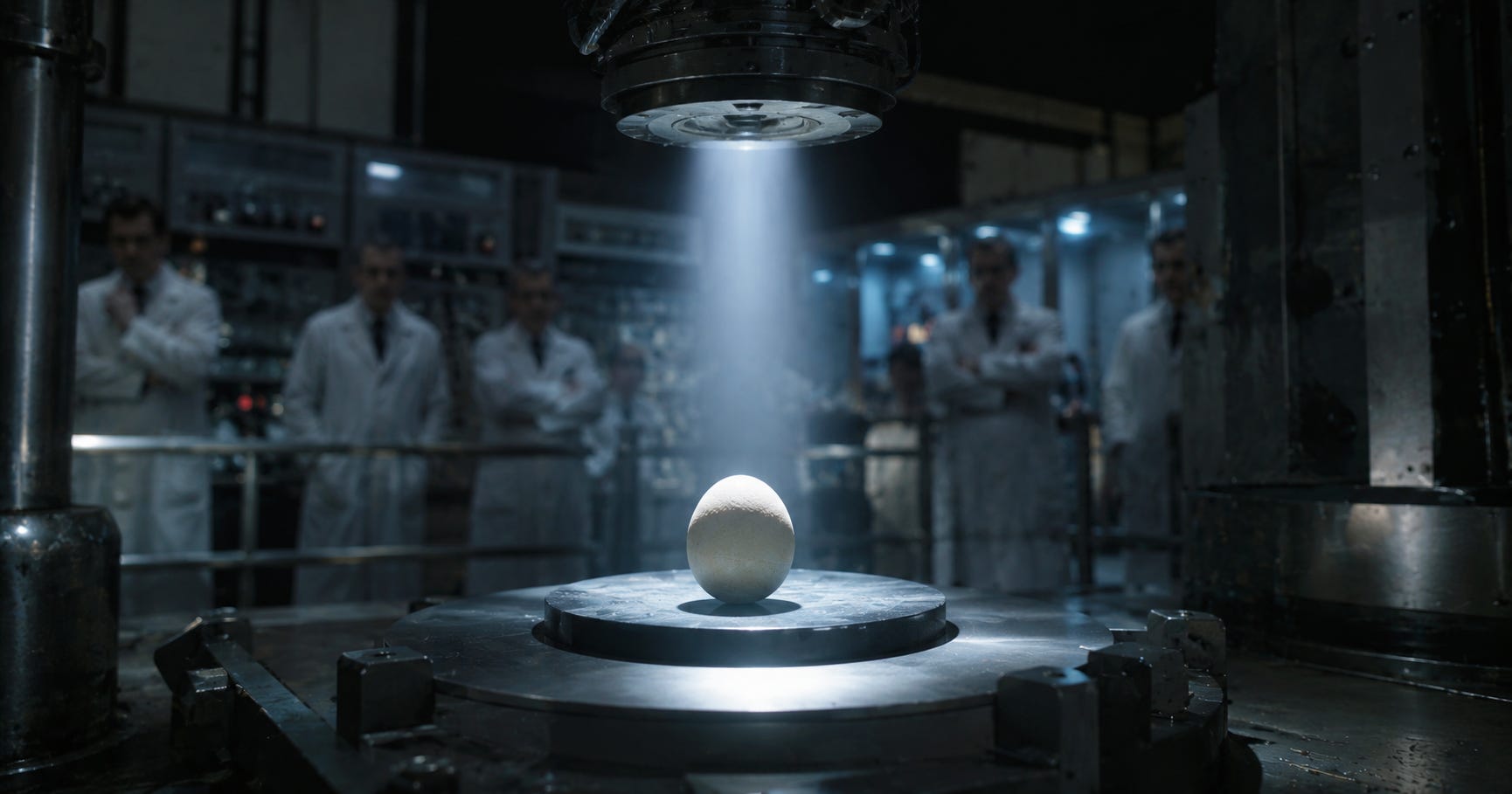
He coated an egg with Starlite and held a blowtorch directly against it for five minutes. The egg was unharmed. He cracked it open. The yolk was still raw. The audience watched in silence.
Over three thousand inquiries flooded in after the broadcast. NASA expressed interest. Boeing expressed interest. The British Atomic Weapons Establishment — which had spent forty years trying to develop materials that could withstand a nuclear flash — invited Ward to bring Starlite for testing. Under laboratory conditions designed to simulate a nuclear detonation, at ten thousand degrees Celsius, Starlite held.
The Impasse
What followed was one of the most frustrating episodes in the history of materials science.
Ward refused to patent Starlite. He refused to share the formula with any of the organizations that came to him. He refused to allow unsupervised testing — correctly reasoning that any sufficiently sophisticated laboratory could reverse-engineer the material from a sample. He insisted on retaining fifty-one percent ownership of any commercial venture built around his invention. His asking price fluctuated wildly. His negotiating positions were, by most accounts, impossible to meet.
NASA walked away. Boeing walked away. Defense agencies walked away. Ward maintained that Starlite was worth billions and that he would not be taken advantage of. “I’m perfectly happy saying it is what it is and it does what it does,” he told a reporter enigmatically in a 1990s interview. He never said what it was or how it worked.
Maurice Ward died in 2011 at the age of seventy-seven. He had earned nothing from Starlite. He had shared the formula with no one outside his immediate family. His wife and four daughters, when contacted after his death, produced no samples and no recipe. A company called Thermashield LLC claimed to have purchased rights from his estate in 2013 — but without the actual formula, the purchase amounted to a name and a handful of old test samples.
The formula, if it ever existed as Ward described it, is almost certainly gone.
Was It Real?
Here is what makes the Starlite story genuinely strange: serious people took it seriously.
The British Atomic Weapons Establishment tested it under conditions designed to simulate nuclear weapons and reported positive results. NASA scientists examined it. Aerospace engineers from major companies sat across the table from a hairdresser and treated his invention as worth pursuing. The raw egg demonstration was performed repeatedly under controlled conditions and never failed.
No one ever proved Starlite was a hoax. No one ever proved it was real. It exists in the permanent middle ground of things that were demonstrated but never explained — witnessed but never understood. Amateur chemists still post recipes online. University students still attempt to recreate it. The Institute of Physics has written about it as one of the most tantalizing unsolved mysteries in materials science.
A material that could have revolutionized aerospace, fire safety, and nuclear shielding may have existed in the kitchen workshop of a hairdresser in Hartlepool. We will likely never know.
The Record Shows
Maurice Ward’s tragedy isn’t that the world ignored him. It’s that the world came running and he couldn’t bring himself to let it in. His fear of being exploited — of giving away something worth billions for nothing — was reasonable. His response to that fear was not. He held so tightly to his secret that it died with him, and the world lost whatever it was he had found. We will never know if Starlite could have saved lives. We only know that a man who may have invented one of the most remarkable materials in history spent twenty years saying no — and left us with a blowtorch, a raw egg, and no answers at all.
Sources
· Wikipedia — Maurice Ward (en.wikipedia.org/wiki/Maurice_Ward)
· Historic Mysteries — Starlite: The Mysterious Material That Could Not Burn (historicmysteries.com)
· Everything Everywhere — Starlite: The Miracle That Never Was (everything-everywhere.com)
· Institute of Physics — The Enigma of Starlite (spark.iop.org)
· UC Merced / KVPR — Miracle or Hoax? Students Attempt to Recreate Starlite (kvpr.org)
If someone forwarded this to you and you’d like to receive Lost in the Record weekly, subscribe free at lostintherecord.substack.com
Wowow!! Amazing story. Tragic that the world will never know what Starlite was or how it could have changed things. 😓 The very thing he was afraid of with others, he was guilty of himself....GREED!! ☹️
Give this a watch!
https://www.youtube.com/watch?v=W4nnLP--uTI